
Biomimicry Design Changed Japan’s Bullet Train and Could Change Our Future Too
Biomimicry design sounds like some futuristic buzzword, but one of its most talked about success stories started with a very real engineering headache in Japan.
Back in the late 1980s, Japan’s Shinkansen bullet train was already a real marvel of speed. It was fast enough to impress the world, but there was a serious issue that residents living around railway tunnels could not really ignore. Every time the train goes through a tunnel, compressed air built up in front of it, then it exploded outward when the train came out. The result was a thunder like boom loud enough to be heard hundreds of meters away.
For a place where dense residential neighborhoods often sit close to rail infrastructure, this was more than a simple technical inconvenience. It became a public problem.
Engineers had to find a way to make the train quieter, without really giving up it’s performance. What came next is still one of the most fascinating examples of innovation inspired by nature. Japanese engineer Eiji Nakatsu, who was both a railway engineer and a pretty passionate birdwatcher, basically looked away from conventional design manuals and toward wildlife instead. That choice, changed transportation history in a way that people still talk about today.
Biomimicry Design and the Bird That Saved a Train
Nakatsu noticed something remarkable about the kingfisher, a bird famous for diving into water at high speed with barely a splash. Its sharply shaped beak allows it to transition smoothly from air into water without creating dramatic pressure disruption.
That same principle could solve the Shinkansen’s tunnel boom issue.
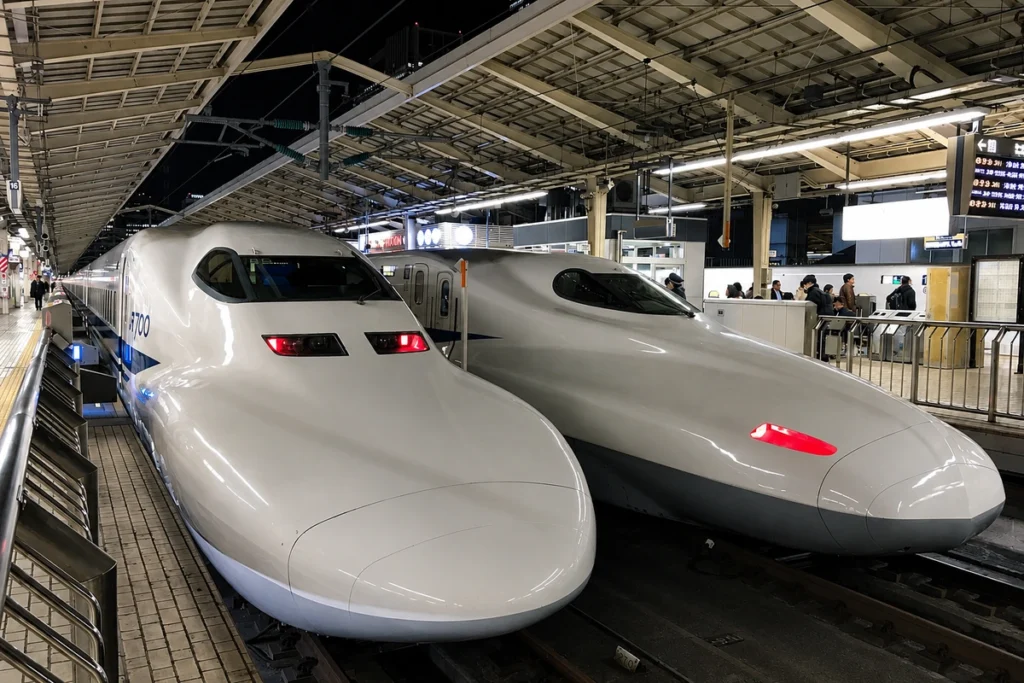
Engineers tested multiple nose shapes before settling on a design strongly influenced by the kingfisher’s beak. The redesigned train nose dramatically reduced pressure waves. The result was impressive. The upgraded Shinkansen became faster, quieter, and more energy efficient.
The redesign did not stop there.
Owls also played a role. Their feather structure allows near silent flight, making them ideal inspiration for reducing aerodynamic noise around the pantograph, the structure connecting the train to overhead power lines.
Even penguins contributed to the concept. Their sleek body shape, built for smooth movement through water, influenced supporting components to improve airflow performance.
When the redesigned 500 Series Shinkansen entered service in the 1990s, it became a powerful proof that nature often solves engineering problems long before humans identify them.
Also Check | Leonardo da Vinci’s Self Supporting Bridge Design Was So Genius
What Biomimicry Really Means
Biomimicry is more than copying animal shapes.
The concept got popular with science writer Janine Benyus, her landmark work introduced the idea that nature should be treated not just as scenery, but also like a mentor for invention. Her main point was refreshingly simple. Nature has spent about 3.8 billion years refining answers through evolution. That is an enormous research and development advantage humans can learn from.
In practical terms, biomimicry means asking a powerful question.
How has nature already solved this problem?
That mindset has inspired technologies across industries, from transportation and architecture to healthcare and computing.
Biomimicry Design Is Quietly Reshaping Modern Technology
The bullet train story gets most of the attention, but it is far from the only example.
Hospital designers have studied shark skin because its microscopic texture naturally resists bacterial buildup. That has inspired cleaner surface materials.
Researchers have looked at gecko feet to invent adhesives that can stick without all the messy chemicals.
Architects have examined termite mound ventilation systems, to get buildings cooler without leaning too hard on air conditioning.
Wind farm planners even studied how fish move in coordinated schools, because that helps reduce drag and make turbine layouts more efficient.
What makes all of these examples so compelling is that they aren’t just science fiction ideas. Lots of it is already showing up in commercial design and sustainability plans, in real life.
Lately, climate conscious innovation has brought biomimicry back into spotlight. As industries get squeezed to cut emissions, waste, and energy use, nature inspired design feels less like a curiosity, and more like a real competitive advantage.
Also Check | Shocking Secret Weapons That Used During Vietnam War
Three Ways Designers Learn from Nature
One of the easiest ways to understand biomimicry is by breaking it into how inspiration is borrowed.
The first is mimicking form.
This means copying a shape or physical structure. The kingfisher train nose is a classic example. Another example is self cleaning coatings inspired by lotus leaves. Water beads on these surfaces and carries dirt away naturally.
The second is mimicking process.
Nature has incredibly efficient way of doing communication, coordination, and adaptation. You can see it in ant colonies, in bee networks, and in flocking birds. Those natural patterns have inspired software systems, logistics models, and the autonomous movement technologies.
The third is mimicking ecosystems.
This is where the idea becomes bigger than individual products. Natural ecosystems waste almost nothing. One organism’s leftovers become another organism’s resource. That same principle now appears in circular economy strategies where companies attempt to reuse materials instead of sending waste to landfills.
This approach is gaining traction because businesses increasingly recognize that sustainability is not just ethical. It is financially smart.
Why Nature Inspired Innovation Feels More Relevant Than Ever
The world today faces very different engineering hurdles than back in the 1990s.
Cities are getting hotter. Energy costs are increasing. The infrastructure workload is rising. Waste handling is becoming harder. And consumers now expect more products that are greener.
Traditional engineering still matters, of course. But biomimicry adds something else, something slightly unusual. It supports a kind of solution design that plays along with natural principles, rather than constantly pushing back against them.
That mindset is especially attractive in sustainable design.
A building that cools itself more efficiently saves money.
A transport system that uses less electricity lowers emissions.
A manufacturing model that treats waste as reusable input improves both margins and environmental performance.
These are not abstract benefits. They are measurable business outcomes.
Also Check | The Shocking Ice Age Tricks Ancient Humans Used to Stay Alive
The Bullet Train Story Still Matters
The Shinkansen story continues to resonate because it captures something surprising about innovation.
The breakthrough did not come from a bigger computer or a more expensive lab.
It came because one engineer happened to love birdwatching.
That detail matters because it reminds us, innovation does not always come from staying inside our professional bubble. Sometimes the best solutions show up when expertise bumps into curiosity.
Today, biomimicry is influencing product designers urban planners, robotics researchers, and sustainability experts around the world. But the lesson still stays beautifully simple.
Nature is not just something humans use.
It is something we can learn from.
And if a kingfisher could help redesign one of the world’s fastest trains, there is every chance the next big breakthrough is already flying , swimming, or growing somewhere around us.