
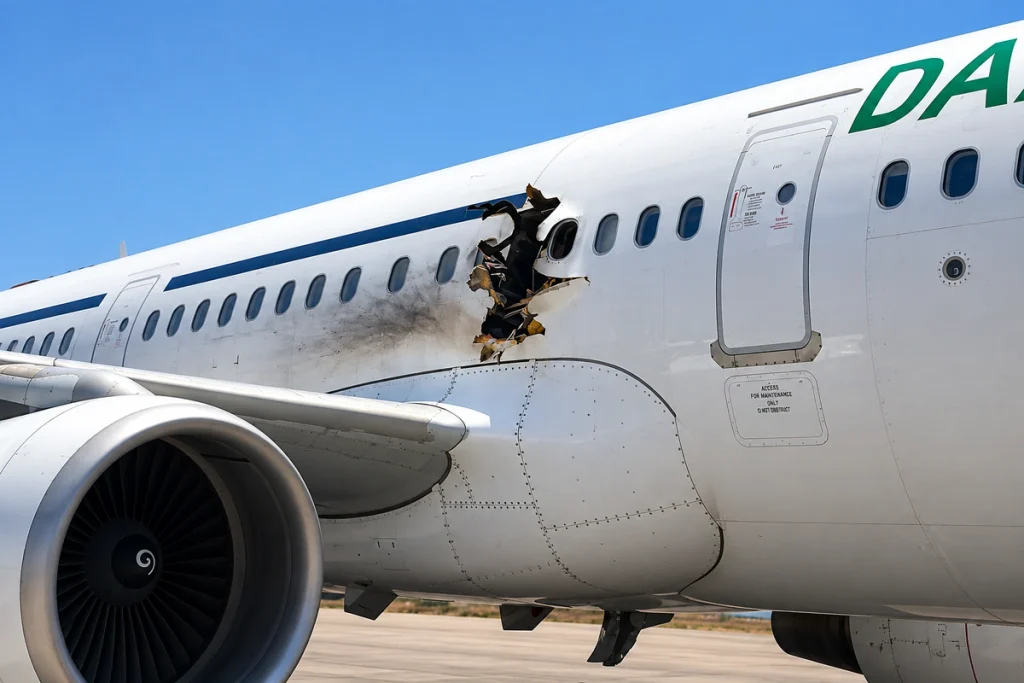
The most surprising thing about the 2016 Daallo Airlines bombing is not that there was a bomb on board. It is the fact that the would-be bomber was tossed out of the plane through the hole he caused and became the only victim of the attack.
The strange thing, however, is also that the events leading up to the attack are even more puzzling than the attack itself.
It all happened on 2 February 2016, when Daallo Airlines Flight 159 was flying from Mogadishu, Somalia, to Djibouti. The Airbus A321 carried dozens of passengers when, fifteen to twenty minutes into the flight, the aircraft exploded.
The blast broke a one-meter hole in the fuselage, causing the cabin to depressurize. Oxygen masks opened, and passengers were forced to evacuate the affected area, but the plane remained controllable. It was returned to Mogadishu, where it landed without further issues.
Also Check | The Village Where Fires Appeared From Nowhere
However, one passenger was not present during the landing.
His body was found near Balad, north of Mogadishu – and identified as Abdullahi Abdisalam Borleh, a fifty-five-year-old Somalian. It was concluded that Borleh had brought the bomb on board, and his laptop computer was the cause of the incident.
The laptop, in fact, appears to be the story’s centerpiece.
The authorities were able to obtain airport surveillance footage, showing that Borleh was given a laptop by airport staff after it had gone through the security checks. It appears that airport insiders had allowed the bomber to pass through their defenses. The case pursued not only an international terror investigation, but even more importantly, the responsibility for protecting the airport itself. This puts the episode in a different light, as it goes beyond the typical hijacking scenario and asks what could happen if airport security failed to do its job.
There was also something strange about Borleh’s travel plans.
He was apparently scheduled to fly with Turkish Airlines, but his flight had been canceled due to some unspecified reasons and he had transferred to Daallo. The new flight had only carried some of the seventy-four passengers who had been booked to arrive in Djibouti. It turns out that almost all of those passengers had been on the Turkish Airlines flight, which had been canceled due to weather conditions. This leaves Borleh as the only one to have changed his plans at the last minute. And this could be significant, because the next odd thing that happened was that Borleh apparently tried to change his seat.
The flight’s CEO stated that the suspected terrorist had not been in a window seat initially and that he had asked another passenger to switch with him. The value of this information is that it shows how the attack could have been prevented.
The final strange circumstance surrounding this matter is the altitude at which the bombing took place.
The explosion happened at approximately 11,000 feet, well below the 30,000 feet at which the aircraft should normally cruise. Modern investigators state that this was the reason the plane did not plummet to the ground, as the difference in air pressure at such a low altitude is not enough to cause a rapid loss of pressure comparable to that at higher altitudes. The UN reported that an explosive device hidden in a laptop had caused the incident, and the attack ultimately only claimed one life, Borleh’s, with Al-Shabaab claiming responsibility for it.
This, in fact, is the point where the oddity of this case concludes.
Also Check | The Incredible Man Who Cheated Death Seven Times
While the attack itself is certainly strange enough, it is also notable for having a long chain of “what ifs.” The terrorist had used an airport’s security against it, and it was ultimately airport insiders who allowed the attack to happen. He had even managed to get on the wrong flight due to a last-minute transfer, and the fact he was in a different seat ultimately saved him as well. All of these strange coincidences contributed to the attack ultimately claiming only one life.
It could be stated, however, that the most remarkable thing about this case is that the focus on the laptop itself obscured the fact that it actually went through a much more important security flaw – the human factor. That ultimately became the weakness, and it was the reason why Flight 159 was attacked.

A passionate blogger, content writer, and digital explorer, specialize in writing engaging, and value-driven articles across diverse niches.