
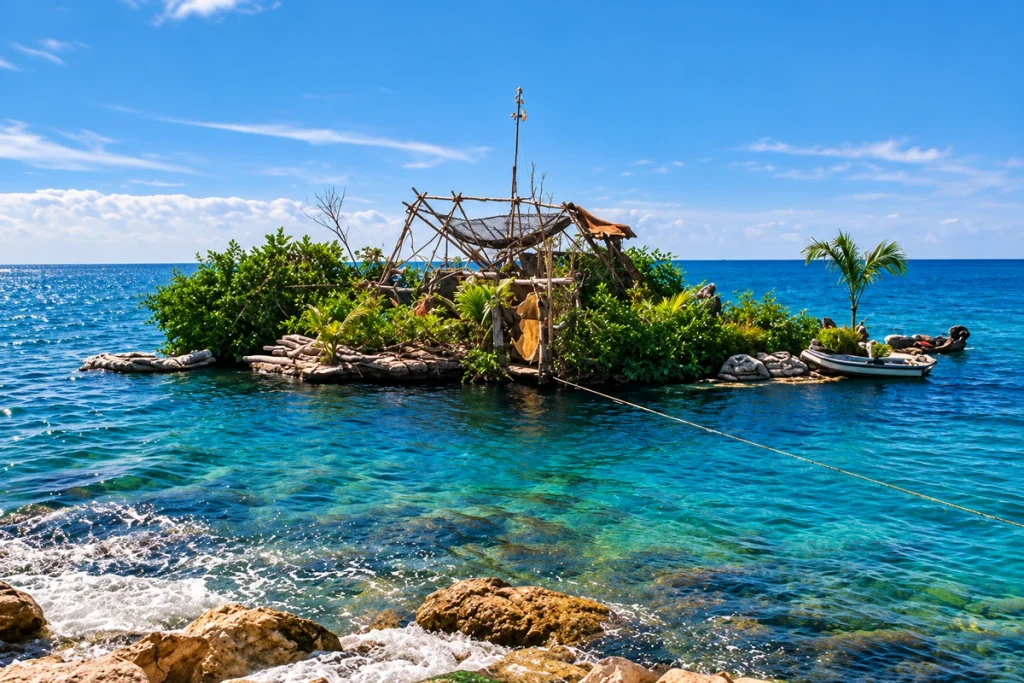
Most people think of an island as something nature creates over thousands or millions of years. Richart Sowa had a different idea. What if land could be assembled instead?
In the late 1990s, the British artist began turning discarded plastic bottles into the foundation of something that looked almost impossible: a floating island where a person could actually live. His creation, eventually known as Spiral Island, was built near Mexico’s Caribbean coast and became one of the strangest experiments in recycled architecture.
But the bottles were only the beginning.
Sowa collected huge numbers of empty bottles and packed them into nets made from reused sacks. The bundles created pockets of trapped air beneath a platform made from materials including bamboo and plywood. Sand and soil were then added above the structure, giving the floating platform the appearance of ordinary land. The first island eventually used roughly 250,000 bottles and grew to about 66 by 54 feet.
Also Check | 5,300-Year-Old Yeast Was Used to Bake Bread
Instead of treating plants as decoration, Sowa allowed them to become part of the structure. Mangroves were planted across the artificial ground, and as their roots spread through the underlying materials, they helped bind different sections together. In other words, the island was not simply a pile of bottles supporting a garden. It gradually became a combination of human construction and biological growth.
That distinction is rarely explained when the story is retold.
The island was designed to become stronger through time as roots developed. Sowa’s own descriptions say the mangroves also helped protect the bottles from sunlight and created habitat beneath the floating structure. Other accounts describe marine life developing around the island as well.
Then came another unusual detail: the island was designed as a home rather than merely an art installation.
Spiral Island eventually contained a two-storey house, beaches, a solar oven and a self-composting toilet. The concept was surprisingly close to a small off-grid settlement, except that its foundations were floating on thousands of discarded containers.
Yet the experiment exposed a problem that has little to do with plastic.
Also Check | The Man Who Survived 133 Days Alone at Sea
An artificial island still needs a place where authorities will allow it to exist.
Sowa’s first major island was affected by development and local restrictions, while Spiral Island was eventually moved from its original setting. After being exposed to Hurricane Emily in 2005, the structure was washed onto the shore. Its destruction did not end the experiment. Sowa began again.
The second project, Joyxee Island, was constructed around Isla Mujeres beginning in the late 2000s. Reports describe a larger and more elaborate floating home containing more than 100,000 bottles, a house, gardens, solar-powered features, ponds and even a wave-powered washing machine.
That second attempt reveals the most interesting part of Sowa’s story.
He was not simply trying to prove that plastic bottles float. Everyone already knows they do.
He was testing whether discarded materials could become the foundation of an entire living system.
The bottles provided buoyancy. Nets provided containment. Wood created the platform. Soil created growing space. Plants supplied shade and roots. Solar energy provided power. Ocean movement could be turned into mechanical energy. Each part had a different job, but together they created something resembling a tiny floating ecosystem.
And that is why the story is more interesting than the usual “man builds island from plastic bottles” headline.
Sowa was effectively experimenting with living architecture, where the structure was expected to change as nature grew through it.
Also Check | The Mushroom That Makes People See Tiny Elves
The experiment also had an important weakness: an island can become stronger through roots and vegetation, but that does not make it immune to extreme weather. Hurricane Emily demonstrated the difference between being structurally clever and being able to withstand a powerful storm. Later storm damage also affected Joyxee Island, which was eventually dismantled.
So the remarkable lesson of the floating island is not that anyone can simply collect bottles and build land.
It is that Sowa tried to blur the boundary between waste, architecture and nature.
He took something designed to be thrown away and imagined it as a foundation. Then he added plants that could eventually become part of that foundation themselves.
For a while, it worked.
And even after the islands disappeared, the experiment left behind a fascinating question: perhaps the future of unusual architecture will not always involve building against nature. Maybe some structures could be designed to let nature gradually become part of the structure itself.

A passionate blogger, content writer, and digital explorer, specialize in writing engaging, and value-driven articles across diverse niches.