
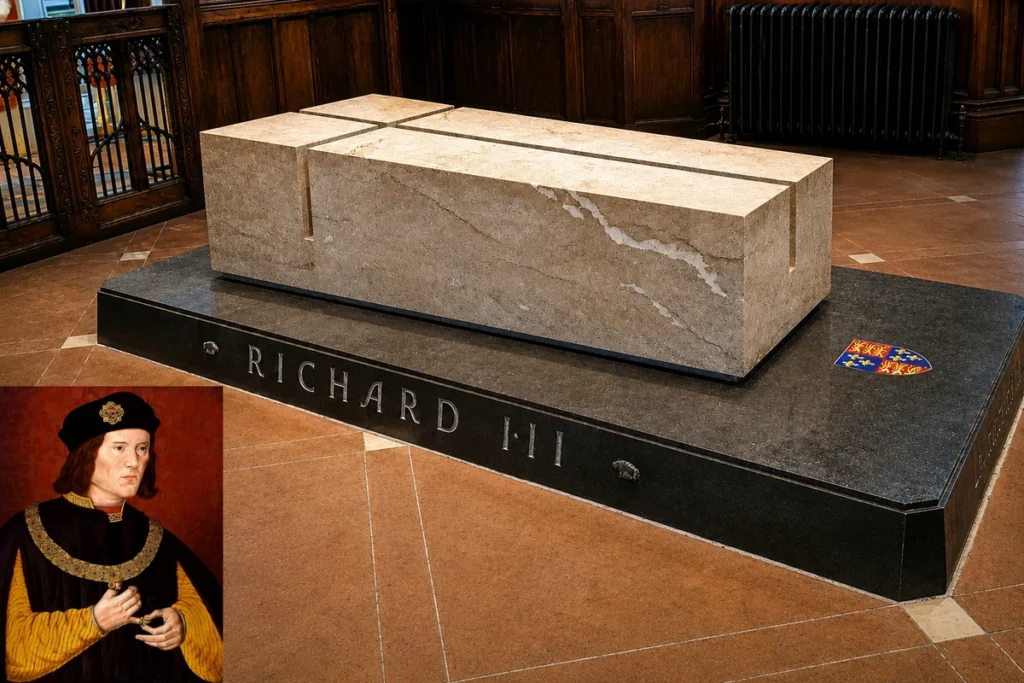
How a Lost English King Was Found Beneath an Ordinary Parking Lot
The Discovery of King Richard III remains one of the most fascinating historical records of modern times. It almost sounds like the script of a film. A king has been gone for over five centuries, and somehow historical truth gets remixed through rumours. A parking lot ends up as the centre point for global attention, and then science walks in and solves what looked nearly impossible.
After he died at the Battle of Bosworth in 1485. His death ended the Plantagenet dynasty and opened the door for Tudor rule under Henry VII. Old records claimed Richard’s body was taken to Leicester and buried at Grey Friars, which was a Franciscan friary. But the exact burial spot faded from public memory as time passed.
The mystery continued to exist for centuries
Discovery of King Richard III and the Birth of a Historical Mystery
Shortly after Richard’s death, accounts suggest his body was publicly displayed in Leicester before burial. He was not given the grand royal farewell one might expect for a king. Instead, he was buried quickly at Grey Friars.
For a while, people knew where he rested.
Then history took a dramatic turn.
In 1530s, during the dissolution of monasteries under Henry VIII, religious properties across England were dismantled or repurposed. Grey Friars was destroyed. Buildings rose over the old site. Land ownership changed. Generations passed.
Then came historian John Speed in the early seventeenth century.
Speed published a story claiming Richard’s remains had been removed by an angry crowd and thrown near Bow Bridge into the River Soar. That tale captured public imagination and became widely accepted, despite weak evidence.
For years, people believed Richard’s grave had been lost forever.
Modern researchers later challenged that version of events, finding strong evidence that the Bow Bridge story was more legend than fact. The University of Leicester’s research into the Grey Friars excavation and later DNA confirmation helped settle the issue decisively.
The Woman Who Refused to Let the Story End
The turning point came thanks to Philippa Langley, a screenwriter and historian who dedicated her life to studying Richard III.
Langley dedicated her research efforts to studying the king’s disappearance from the early 2000s onward. She rejected common myths, instead studied original documents, historical maps and forgotten records.
This changed everything.
Researchers noticed that the Grey Friars story might have been misplaced in historical records. They spent very much time in overlaying aged maps with the modern city pattern, and they ended up seeing a pretty ordinary location where the burial zone probably was.
A municipal parking lot in Leicester doesn’t exactly seemed like a royal tomb. But, history often hides in the least glamorous places.
The Dig That Changed British History
In august 2012, a few archaeologists from Leicester University launched a targeted excavation program. Their funding was tight, so there wasn’t much space for guesswork at all. The trenches had to be placed strategically,
Then, almost unbelievably, the breakthrough came almost immediately.
Within hours of digging, human remains appeared.
Not just any skeleton.
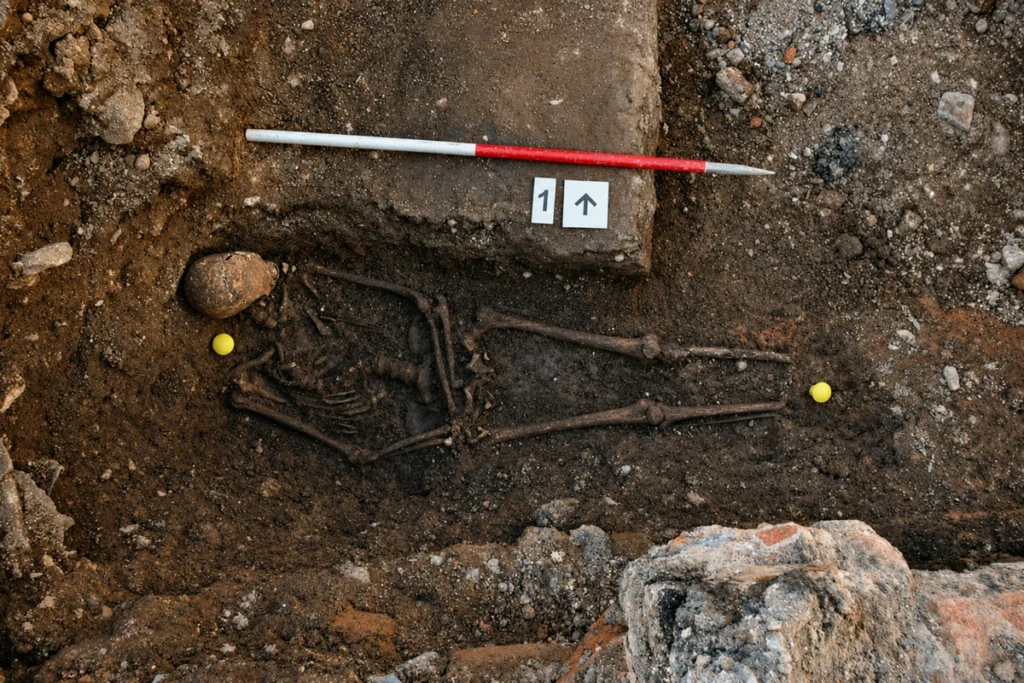
The bones belonged to an adult male with a pretty severe spinal curvature. There were also clear signs of violent trauma, most notably around the skull.
Richard III had been described for years in dramatic historical portrayals, often as physically deformed. But when modern analysis was done, it didn’t really line up with that exaggerated hunchback look. Instead, it pointed to scoliosis, a more realistic condition that matches what people are seeing, rather than the later, popularised image.
Still, clues alone were not enough.
The world needed proof.
Also Check | Da Vinci bridge design reveals brilliant ancient engineering secret
Discovery of King Richard III Confirmed by Science
This is where the story starts to feel a lot more extraordinary. Archaeologists combined historical research with forensic science, osteology plus genealogy, radiocarbon dating, and genetic testing too.
The skeleton’s age matched Richard’s age at the time of his death. The injury patterns also fit with the battlefield trauma.
Then came DNA.
Scientists studied mitochondrial DNA, because it transmits through maternal ancestry. This research made it possible to match skeletal genetic data with Richard’s family descendants.
The researchers traced an unbroken maternal link that extended through multiple generations to Michael Ibsen, who is a current family member.
The DNA matched.
That was the moment speculation turned into scientific certainty.
A major peer reviewed study concluded the evidence overwhelmingly supported identification of the remains as Richard III.
Why Carbon Dating Nearly Created Confusion
One unexpected challenge nearly complicated the identification.
Initial radiocarbon dating suggested the remains might be older than Richard III.
That could have derailed the case.
But scientists looked deeper.
They discovered the individual had consumed a protein rich diet heavy in seafood. This matters because marine diets can affect radiocarbon dating results, making remains appear older than they really are.
Once corrected, the timeline fit Richard perfectly.
It was a reminder that science is rarely a straight line. Good investigations often require questioning early conclusions rather than accepting them blindly.
A King Returns to History
In February 2013, the lost king had been found, and the official announcement confirmed what many had begun to suspect. A discovery beneath a parking lot solved one of England’s longest-running historical mysteries.
The discovery also reshaped how people view Richard himself.
For centuries, his image was heavily influenced by political storytelling and dramatic literature. Modern scholarship continues to revisit his legacy with fresh evidence and less Tudor era bias.
Even recent projects exploring his reconstructed voice and renewed public exhibitions show that fascination with Richard III remains alive today.
Also Check | Famous Foods That Were Invented by Accident
Why This Story Still Captivates the World
What makes this story unforgettable is not just the archaeology.
It is the human element.
A forgotten king.
A centuries old rumor accepted as fact.
A determined researcher who refused to let the mystery stay buried.
And science powerful enough to connect living people with someone who died in medieval England.
The Discovery of King Richard III shows that history is not always locked up in dusty files. Sometimes it’s just waiting there quietly beneath ordinary places, unnoticed by thousands walking above it.
And sometimes, the whole thing changes because someone is ready to ask a simple question.
What if the story everyone believed was wrong?

A passionate blogger, content writer, and digital explorer, specialize in writing engaging, and value-driven articles across diverse niches.