
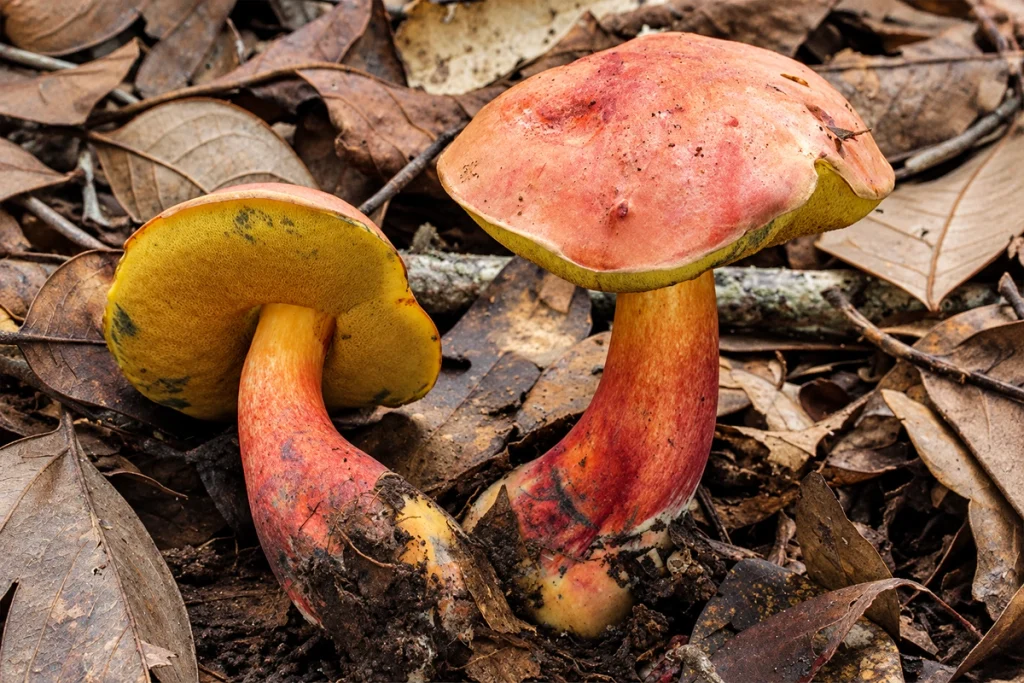
Imagine eating a mushroom that seems like normal fresh food from forest, and hours later you start to feel odd. Then you notice the room is not empty. Tiny people are all around, moving and whispering as if they have always been there.
They may appear to march beneath doors, climb furniture, move along walls or gather around you. The strangest part is not simply that people hallucinate. It is that different people can report remarkably similar miniature figures after eating the same mushroom.
The strange mushroom that causes this bizarre phenomenon is called Lanmaoa asiatica. It is a type of bolete that grows in parts of southwestern China and in the Philippines. In Yunnan, people have long consumed it. Many say it tastes good. Still, if it is cooked the wrong way, it can lead to a rare type of poisoning.
For a long time, doctors have noticed cases like this. Scientists have recently begun to find out what actually triggers it.
Also Check | The Dog Walked 2,551 Miles Across America to Find Home
A key hint is what investigators did not see.
Some people connect this mysterious hallucinogenic mushroom with psilocybin. Others linked it to ibotenic acid due to its effects on our nervous system.
A phylogenomic report published in 2026 found out that L. asiatica does not have the common biosynthetic genes tied to making psilocybin or ibotenic acid.
Because of that, the mushroom probably produces totally different compound entirely.
In other words, the mystery may not be an unusual dose of a familiar psychedelic. It could involve a molecule that science has not properly identified yet.
That possibility makes the mushroom particularly interesting to researchers studying the brain.
Another detail people miss is the timing. The strange hallucination events did not start right after eating mushrooms. In a 2024 report on 81 patients who were treated for L. asiatica poisoning, around 69% had delayed neuropsychiatric signs. For many, the first signs came roughly 12 to 24 hours after the person ate it. By comparison, gastrointestinal symptoms often showed first.
That separation could be important.
It suggests that the bizarre visions may not simply be the immediate result of the mushroom irritating the nervous system. The responsible substance, or substances, might need to be absorbed, transformed by the body or reach a particular concentration before the brain effects appear.
Then there is the cooking mystery.
Also Check | The Octopus That Learned To Play Piano
The mushroom is not simply famous because it is poisonous. It is reportedly eaten as food in the region, while the bizarre neurological effects are associated particularly with improper preparation. This creates an unusual situation in which the same species can be considered a culinary mushroom and a source of poisoning depending on how it is prepared.
Researchers therefore have another question to answer: what exactly changes during cooking?
If heat destroys the compound responsible for the hallucinations, identifying that chemical may help explain the odd way this mushroom acts differently from typical psychedelic fungi.
The visions themselves may provide another clue.
Doctors call experiences involving tiny human or human-like figures Lilliputian hallucinations. They are not exclusive to mushrooms. Medical literature has documented similar experiences in people with neurological and psychiatric conditions, and a systematic review of 226 case descriptions found that these hallucinations can be visual or involve several senses.
But L. asiatica presents an extraordinary puzzle because so many people exposed to it report miniature figures.
How could a strange mushroom chemical produce a sharp mental vision, rather than the more common geometric patterns, color shifts, and other effects linked to psychedelics?
Scientists still don’t have any answer yet.
Recent studies have helped the search. Laboratory work and genomic analysis suggest that the mushroom may contain a previously unidentified psychoactive compound, while experiments are being used to investigate potential candidates.
That leaves perhaps the most fascinating possibility of all.
Also Check | The Boy Who Builds An Underground Cave in Anger
The tiny elves may not be the real mystery. It could be the chemical in that mushroom, which forces the human brain to make those strange visions.
Currently, no one has a solid answer. Researchers still need to find out the compound and test what it actually does to our nerves. Then they might be able to explain why one mushroom can turn an ordinary looking room into a miniature living world.

A passionate blogger, content writer, and digital explorer, specialize in writing engaging, and value-driven articles across diverse niches.
1 thought on “Lanmaoa asiatica: The Mushroom That Makes People See Tiny Elves”