
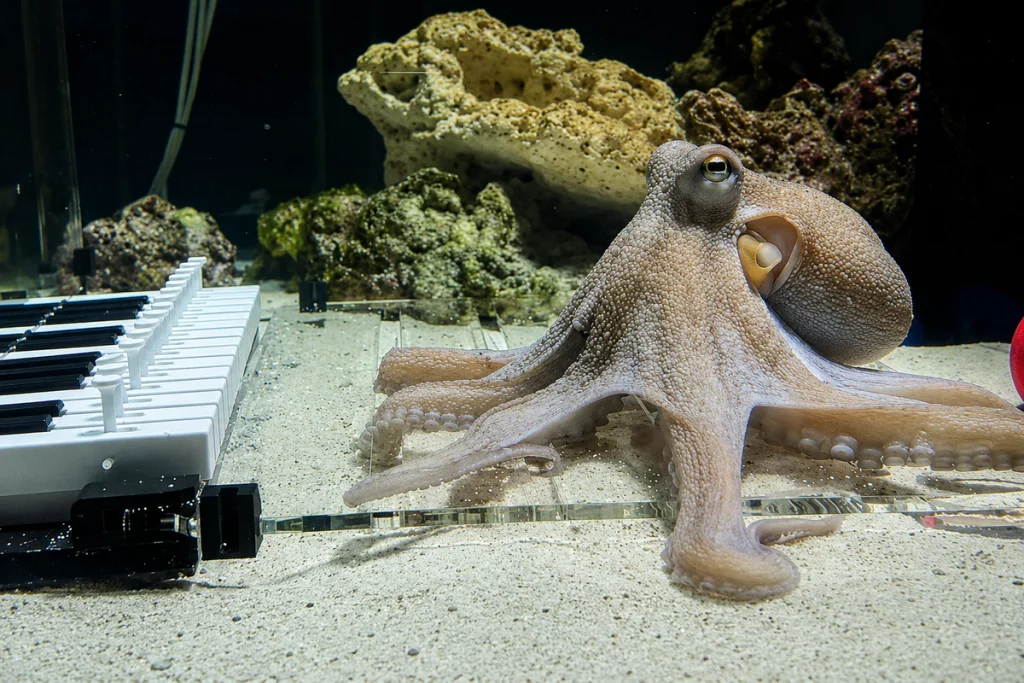
When Swedish musician and YouTuber Mattias Krantz decided to teach an octopus to play piano, the obvious challenge seemed to be teaching music to an animal with eight arms. But that was not actually the hardest part. The real problem was that almost everything about a conventional piano was designed for a human.
The octopus, named Takoyaki or Tako, eventually learned to trigger different notes on a specially designed underwater keyboard after about six months of experimentation. But behind the viral footage is a much stranger story about engineering an instrument around the body and senses of another species.
Krantz first discovered that simply putting keys in front of Tako was not enough. Octopuses naturally use their arms for grabbing and pulling, so pressing a traditional piano key was an unnatural movement. Instead of forcing Tako to behave like a human pianist, Krantz redesigned the controls so the keys could be pulled. That small change was arguably more important than the piano itself.
Also Check | Why Do Crows Bathe in Ants?
A piano makes sense to a human because our ears are built to detect sound traveling through the air. Underwater, the situation is completely different for an octopus. Krantz experimented with vibrations and an underwater speaker so Tako could physically sense what was happening around the instrument. In other words, he was not simply teaching an octopus piano. He was trying to translate the concept of a piano into something an octopus could interact with.
The biggest breakthrough came when Krantz stopped trying to make the keyboard interesting and started making the result of playing it interesting.
He created what became known as the “crab elevator.” A crab, one of Tako’s favorite foods, was placed inside a tube above the keyboard. Each correct key movement caused the reward to move closer. Eventually, completing a sequence brought the crab within reach and this helped Tako progress beyond repeatedly hitting only a small number of keys.
Also Check | The Boy Who Builds An Underground Cave in Anger
Tako was not necessarily sitting at the keyboard thinking about melody, rhythm or musical expression. Marine scientist Jenny Hofmeister suggested that the octopus was more likely learning a chain of actions connected to a food reward. Krantz himself acknowledged that Tako never consistently played the correct notes at the correct time. The animal could reproduce note sequences, including the progression of “Baby Shark,” but the performance could be badly out of tempo.
Rather than just showing that an octopus can understand music, this project points to a quieter idea. You do not have to see something look human to call it smart. Krantz spent time learning how Tako moved on its own, what attracted its attention, and which signals it seemed to care about the most.
The experiment also produced an unexpected relationship. After the formal training, Krantz continued playing guitar while Tako interacted with the keyboard, turning the experiment into something resembling an improvised duet.
Also Check | The Man Who Sat on a Flagpole for 49 Days
Tako never became an underwater Mozart. But Krantz’s strange six-month project showed that an instrument can be redesigned around another creature’s instincts, movement and sensory world. That makes the story much bigger than a viral octopus pressing piano keys.
It becomes an experiment in communication between two completely different kinds of intelligence.

A passionate blogger, content writer, and digital explorer, specialize in writing engaging, and value-driven articles across diverse niches.