
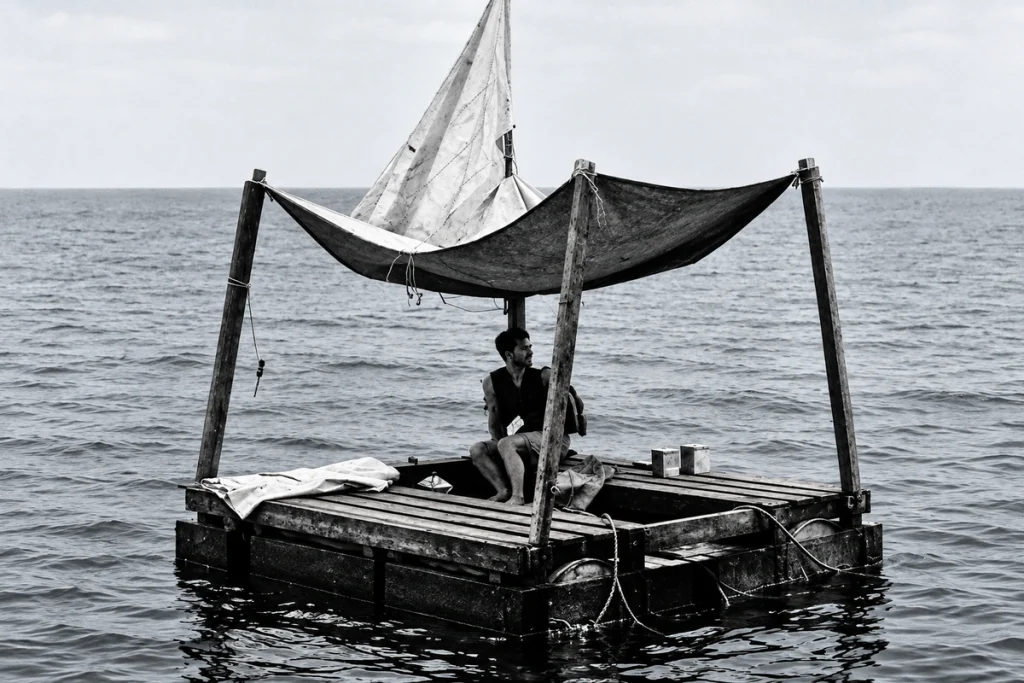
Poon Lim started his journey on a small wooden raft in the middle of the Atlantic. He might not have imagined it would end up with him for 133 days.
His ship, the British merchant vessel SS Ben Lomond had been hit by a German U-boat on November 23, 1942. Lim survived through the sinking. He spent around two hours in the water before he finally reached the raft.
The raft had some basic survival items. There was food, fresh water, fishing gear, and tools for signalling. Still, it was not set up to keep one man going for more than four months.
What stands out is not just that he caught fish. It is how he figured out what to do next, and then used that to move forward again.
Also Check | The Man Who Sat on a Flagpole for 49 Days
At first, Lim used what was already on the raft. Then things started to disappear; every useful object around him had to serve another purpose. A flashlight stopped being just a flashlight. He took out the spring and bent it into a fishing hook. Rope became fishing line. A nail pulled from the raft became another hook capable of handling larger fish. Even a piece of metal from a food tin could be turned into a cutting tool.
Then came the cleverest part.
A small fish was not simply a meal. It became bait for a larger fish. The larger fish could then become food, bait, or a way of attracting seabirds. Fish scraps hanging around the raft also brought unwanted visitors: sharks.
This created a strange survival chain. Lim was effectively converting one tiny resource into several opportunities to find food.
That approach became crucial because he was not an experienced fisherman suddenly dropped into the ocean with a complete survival kit. He had to learn through trial and error while sitting on an eight-foot wooden platform surrounded by thousands of miles of water.
Water was an even bigger problem.
Also Check | The Incredible Man Who Cheated Death Seven Times
The original supply could not last indefinitely, so Lim collected rain using pieces of canvas and other material available on the raft. During dry periods, he faced a much more serious problem than hunger. Some accounts describe him resorting to fluids from animals he caught when fresh water became scarce.
The raft also became his gym.
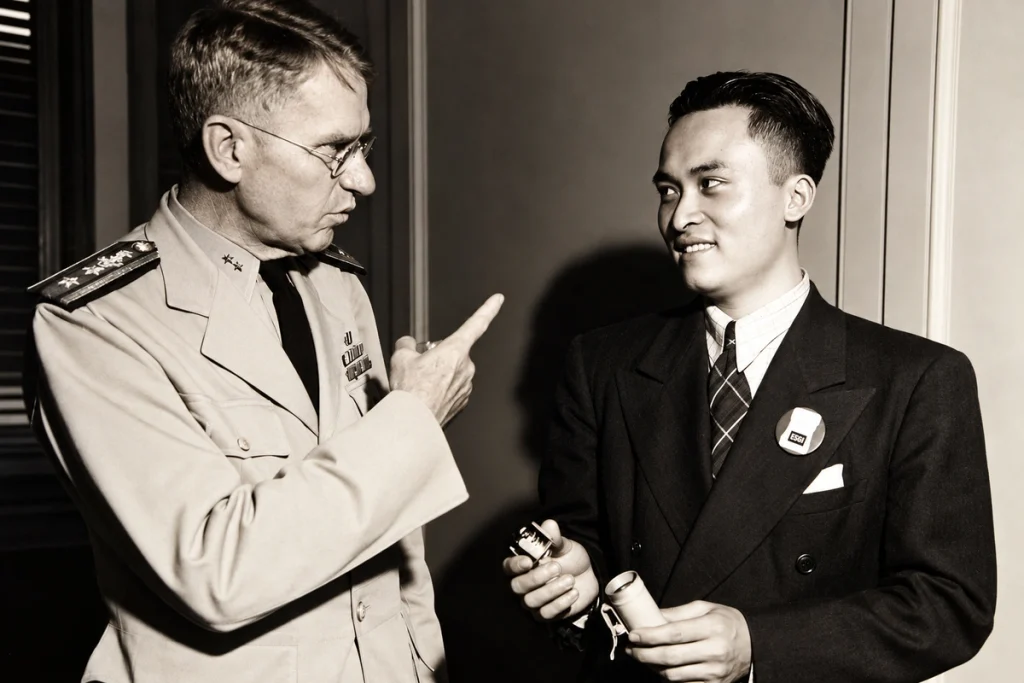
Lim realized that simply sitting there would gradually destroy his physical strength. Reports describe him swimming around the raft when conditions were safe, sometimes twice a day, while keeping himself connected to the raft because he was not a strong swimmer. Sharks sometimes made that routine impossible.
And rescue did not simply fail once.
Lim was reportedly spotted by passing vessels and aircraft during his ordeal, but none resulted in his rescue. One encounter with a freighter was particularly frustrating, while an aircraft sighting was followed by weather that carried the raft away.
Eventually, Lim stopped depending entirely on the idea that someone would find him.
He concentrated on staying alive.
Around the beginning of April 1943, roughly 750 miles to the west, he noticed things that made it seem land was not far off. On April 5, three Brazilian fishermen saw him near the coast of Pará. He had Lost around 20 pounds and looked so drained that the men had to lift him from his raft. Once he reached shore, he slowly got stronger and was able to walk.
Poon Lim’s story is often reduced to one unbelievable statistic: 133 days.
Also Check | Dog Walked 2,551 Miles Across America to Find Home
But the more fascinating detail is what happened between day one and day 133.
He did not discover one magical survival trick. He built a system from almost nothing. A broken flashlight became a hook. A fish became bait. A bird became food and bait. Rain became drinking water. Rope became fishing equipment. Even his own daily routine became another weapon against weakness.
His raft was tiny.
His resources were disappearing.
But Lim kept finding another use for whatever remained.
That may be the most interesting part of the 133-day story: he did not survive because he had enough supplies, but because he continually found different ways to make limited supplies do more than one job.

A passionate blogger, content writer, and digital explorer, specialize in writing engaging, and value-driven articles across diverse niches.
1 thought on “Poon Lim: A Man Who Survived 133 Days Alone at Sea”