
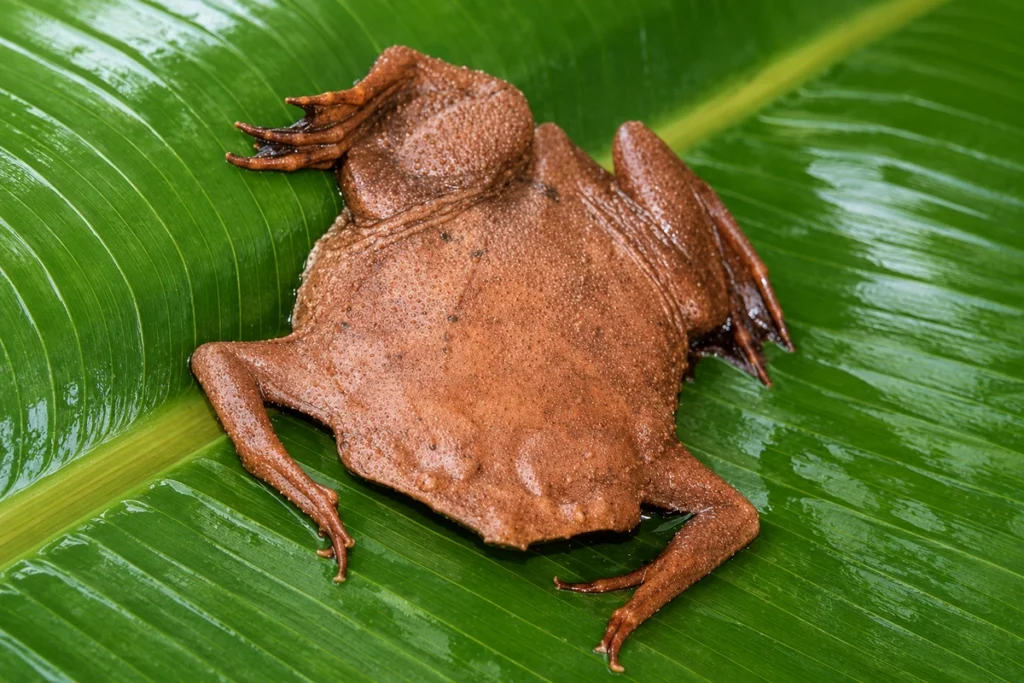
Surinam toad gives birth in a way that looks almost impossible. Instead of leaving her eggs in open water, the female carries them inside small pocket like chambers that form across the skin of her back. Months later, when the time comes, fully formed young toads push their way out and begin life on their own.
This strange amphibian is known scientifically as Pipa pipa. It lives in slow rivers, flooded forests, ponds and muddy waterways across tropical part of South America. Its wide and flattened body helps it blend into dead leaves that lie there on the bottom. From above it can look more like a bit of bark than a living animal.
That disguise is useful because the toad spends a lot of its time resting quietly underwater. Its tiny eyes are not that helpful for hunting in murky water. Instead, sensitive, star-shaped fingertips and a system that detects movement in the water help it locate nearby prey.
When a fish, worm or small aquatic animal comes around, the toad suddenly opens its broad mouth. Water and prey get pulled inside by suction, like a vacuum. Unlike many other familiar frogs, it does not depend on a long sticky tongue to catch a meal.
Also Check | The Mysterious Giant Anaconda of Amazon
How the Surinam Toad Gives Birth Through Its Back
Breeding starts when a male attracts a female with clicking sounds made from underwater. He holds onto her body while the pair perform repeated turning movements and underwater loops. During each movement, the female releases eggs and the male fertilizes them.
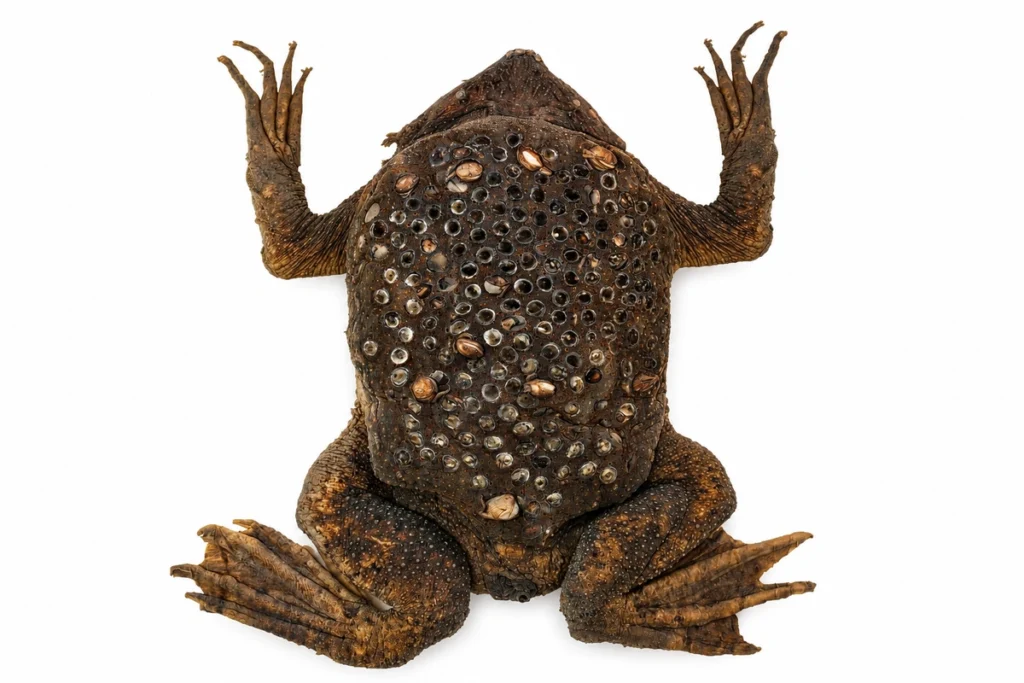
The male then helps to spread the fertilized eggs across her back. Her skin has already begun to soften and thicken in preparation. Over the following hours, the eggs settle into the surface, while new tissue grows around them.
The result is a pattern of separate pockets that can resemble a honeycomb. Each chamber protects one developing offspring. A temporary covering closes the top, keeping the embryo sheltered from many dangers found in open water.
A female commonly carries dozens of eggs, with some accounts reporting roughly sixty to one hundred. The exact number can vary. This makes her back look swollen and uneven, but the young are not growing loose inside her body. They remain enclosed in individual skin chambers.
The Young Skip the Free-Swimming Tadpole Stage
Most people think, a frog beginning life as a tadpole swimming through a pond. But, pipa pipa follows a different path. Its offspring complete their early development while protected on the mother’s back.
They develop tails for a time, but they do not leave the chambers as ordinary free-swimming tadpoles. After roughly three to five months, depending on conditions and the source observed, they emerge as miniature versions of the adults.
The sight can be startling. Small toadlets press against the thin covering and force themselves through openings in the skin. Several may emerge close together, while others appear later. Once free, they can swim and survive independently.
The mother does not continue feeding or guarding them after their release. Her unusual investment happens before birth, through the protected space she carries on her body. Later, she sheds the temporary outer layer, and her back gradually returns to its usual appearance.
Also Check | A Thief Cat That Goes Viral for Stealing Things
Why This Reproductive Method Matters
Producing many eggs is common among amphibians because exposed eggs and tadpoles face fish, insects, drying water and other threats. The Surinam toad takes a different approach by keeping its developing young physically attached and protected.
This does not guarantee that every offspring will survive through this process. However, carrying the eggs can reduce some of the risks they would face if the eggs were scattered in the water. It’s also a striking example of how evolution can solve the same problem in very different ways.
Scientists now recognised more than nine thousand amphibian species that displays an wide range of breeding behaviours. Some create foam nests, some carry tadpoles and others guard eggs on the ground. Even inside that variety, the back-brooding method of Pipa pipa remains one of the most strangest.
The animal may look motionless and plain when it is hidden on a muddy riverbed, but its life story is anything but ordinary. By transforming her own skin into a temporary nursery, the female provides her offspring a protected start before they enter the water as tiny, fully independent toads.