
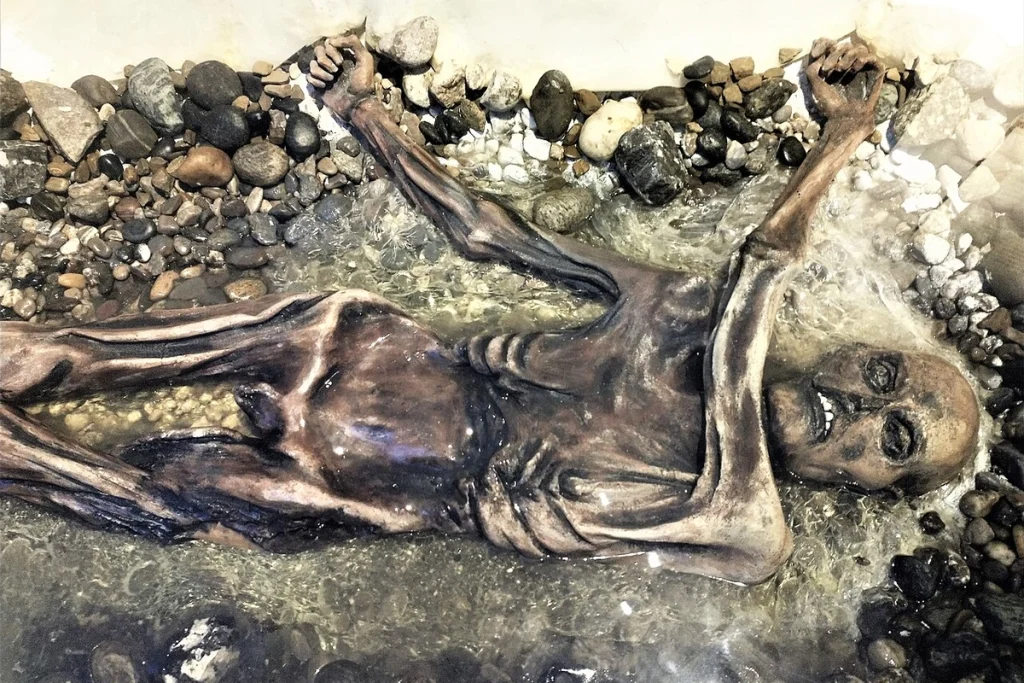
Imagine someone opens a freezer and finds one of history’s most famous ancient bodies, and then realises something is still alive.
That is the strange discovery researchers made while studying Ötzi the Iceman, the remarkably preserved mummy found in the Alps in 1991. Researchers were not only looking for microorganisms around his remains. They also managed to grow a few cold-loving yeasts from samples associated with his remains. Later, these yeasts were used to make sourdough.
The story becomes even stranger when examining the sample origins. They thawed part of Ötzi under controlled laboratory conditions. Then they collected swabs, small pieces of tissue, and water that had thawed inside the body. They did not stop there. They also checked samples from outside sources, such as soil from where he was first found. They sampled items from the museum too, where Ötzi has been kept since then.
That matters because the phrase “5,300-year-old yeast” can be misleading.
The researchers discovered ancient microbial DNA inside Ötzi, with a bacteria that seem to have belonged to the gut microbes. The four yeasts they successfully cultivated, however, were different. They were cold-adapted species such as Glaciozyma, Mrakia, Phenoliferia and Goffeauzyma. The study indicates that these yeasts were probably associated with the glacier environment and colonized Ötzi after his death rather than being organisms that lived inside him while he was alive.
Also Check | Tiny Cup Became a Family’s Biggest Fear
That distinction may actually be more fascinating than the bread itself.
These microorganisms appear to have survived in an environment where ordinary decomposition organisms cannot easily grow. Ötzi is currently stored at about -6°C with very high humidity, conditions designed to imitate his frozen natural environment. Yet the research found evidence that some cold-adapted microorganisms could still grow.
One yeast strain provided an especially strange clue. Glaciozyma became much more dominant in samples collected in 2019 than in comparable samples from 2010. Researchers interpreted this change as evidence that the cold-loving yeast community was not simply sitting there as dead genetic material. Some organisms appeared capable of continuing to grow or reproduce under the preservation conditions.
Then came the kitchen experiment.
At first, the yeast didn’t perform like ordinary baker’s yeast. The researchers had to continuously cultivate and refresh it, slowly allowing it to adapt to flour. After numerous tries over several months, they finally developed a starter that was capable of making the dough rise. Microbiologist Mohamed Sarhan noted that the dough rose within about 24 hours and produced a successful loaf. However, he openly admitted that his limited baking experience meant the bread itself still required improvement.
This is where the discovery takes an unexpected turn.
The discovery may not be a recipe for prehistoric bread. Some yeasts can handle the cold, and that trait could help with fermentation runs that stay cool. Scientists have also suggested other uses, like making beer. Low-temperature fermentation could eventually have industrial advantages because some processes might require less heating.
There is also a conservation problem hiding behind the novelty.
Also Check | The Mushroom That Makes People See Tiny Elves
If microorganisms can survive and remain active around a frozen mummy, then keeping the body cold is not the whole story of preservation. Scientists found living microbial groups linked to ancient organisms, the glacier environment, and the impacts of today’s human activity.
Researchers also found that some of the microbes carried genes that could help break down organic material. That finding gives scientists another reason to look closely at the tiny organisms living around ancient mummies, as they may play a role in how well human remains survive for thousands of years.
So the real surprise is not that scientists managed to bake bread from an ancient mummy.
It is that a body frozen for more than five millennia can still serve as a meeting point between the ancient world and modern microbial life. The loaf was simply the most delicious demonstration that some of those microscopic passengers were far from being ordinary archaeological dust.

A passionate blogger, content writer, and digital explorer, specialize in writing engaging, and value-driven articles across diverse niches.