
Imagine yourself enjoying a scoop of frozen cream on a particularly hot afternoon during the 1700s. There were no ice cream makers, freezers or electric mixers available at all. Yet somehow, people seem to have been able to create cold, fruity and chocolatey desserts of surprising similarity to what we know today. The secret lay in a combination of winter ice, salt, insulated storage and lots of manual work.
The Winter Work That Made Summer Ice Cream Possible
Before refrigeration, ice cream makers had to rely on nature well before they began preparing the dessert itself.
In some colder areas, workers would cut out large sections of thick ice from frozen lakes and ponds.
These sheets were broken up into smaller, manageable blocks and then hauled away to specially built storage buildings known as ice houses.
Here, the blocks of ice were packed away tightly with insulating materials such as straw and sawdust surrounding them, to help keep the cold in.
Some ice houses were built partially underground to keep temperatures down and insulate against exterior heat, and drainage helped remove melted water.
Also Check | Leonardo Da Vinci’s Brilliant Ancient Innovation
This system provided a way to store some of their winter ice for use in other seasons, although it was never a completely reliable source. The ice cream makers had to deal with the limitations of the system, such as how much ice they could store or how far it would have to be transported.
Keeping their ice cream cold began with an entire seasonal supply chain.
The Unexpected Role of Salt
One of the most amazing things about traditional ice cream making was the clever use of salt.
Ordinary ice will begin to melt at about 0 degrees C (32 degrees F). On its own, ice isn’t cold enough to freeze a typical ice cream mixture effectively.
Mixing salt and ice causes the melting point of the created solution to lower.
As the ice melts and more solution forms, it extracts even more heat from the environment, causing the temperature of the ice and salt mixture to be lower than the melting point of normal ice.
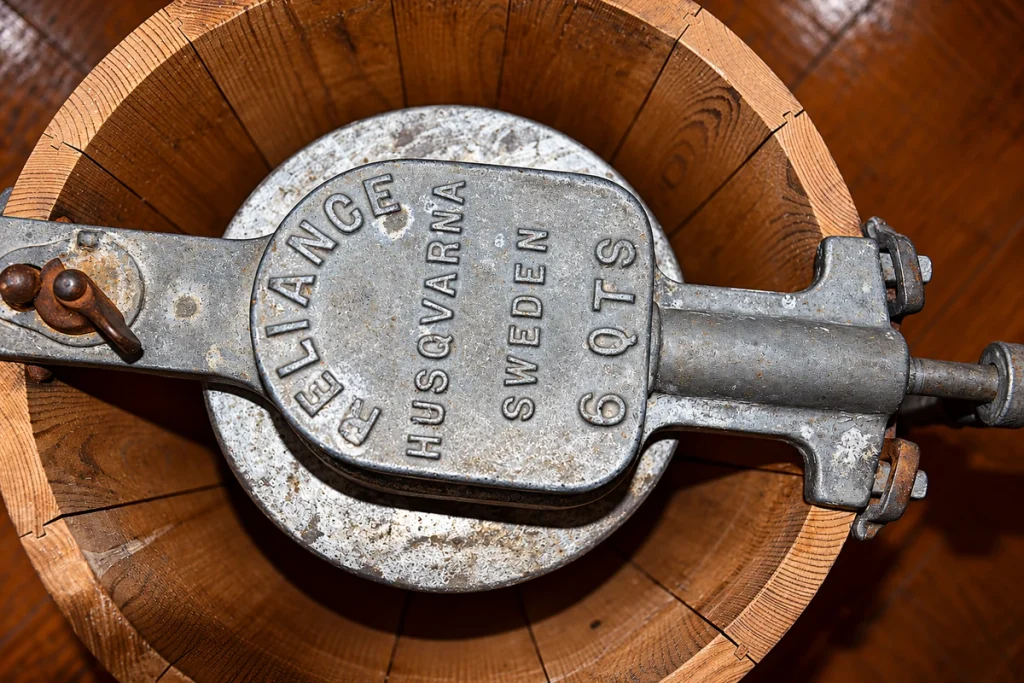
Ice cream makers used this fact by crushing some of their ice and mixing it with salt in a wooden bucket, with a smaller metal one suspended inside.
The cold walls of the outer bucket caused the cream mixture in the inner bucket to freeze, layer by layer, as it was stirred.
This was the beginning of the transition from a liquid mixture into a solid block of ice cream.
Why Someone Had to Keep Turning the Handle
Getting the mixture cold enough was only half the challenge.
Without constantly agitating the liquid and scraping the frozen cream off the sides of the bucket, chunks of icy cream would form and then be mixed with the rest.
This created large, unmelty lumps of frozen creaminess that could make the finished dessert unpleasantly crunchy.
To avoid this, makers kept stirring and scraping, a task that was made simpler in later years by hand-cranked machines.
In 1843, American inventor Nancy M. Johnson was granted a patent for an improved hand-cranked ice cream freezer, which had a rotating dasher to help churn and mix the cream while also scraping the inside of the mixing chamber.
Also Check | The Headless Chicken That Survived for 18 Months
This meant that the cream was turned into a consistent, smooth mixture that could be easily removed.
This simple mechanisation helped reduce the labour and simplified homemade ice cream making.
Why Ice Cream Was Once a Luxury
Ice cream was never a cheap treat.
The main problem didn’t lie in the cream or the sugar, but rather the ice.
This had to be harvested in the cold months, stored, transported and mixed with salt before use.
Both sugar and cream had to be bought, while the preparation required a significant amount of time and effort.
As a result, ice cream was mostly enjoyed by the wealthy, and often served in lavish mansions during grand celebrations or other special occasions.
Wherever there weren’t enough natural sources of ice, it could be even more expensive to produce.
During the nineteenth century, commercial ice harvesting and long-distance shipping made it possible for some desserts to become more widely available, with ice being transported from colder regions to ones where there wasn’t any.
The Hidden Achievement Behind Every Scoop
Making ice cream before freezers existed was truly an exercise in managing heat.
People had to find ways to keep the cold from their winter ice, store it, get it to where they needed it and use salt to make it cold enough to freeze their mixtures.
Then, they had to make sure that the mixture they were freezing didn’t end up with unappetizing icy bits anywhere near it.
The most surprising thing about all this is that the fundamentals of making ice cream haven’t changed to this day.
Also Check | The Mushroom That Makes People See Tiny Elves
Modern machines still depend on making things colder by mixing, just on a larger scale and with electricity.
Long before freezers became a part of the household, human innovation made it possible to enjoy ice cream anyway.

A passionate blogger, content writer, and digital explorer, specialize in writing engaging, and value-driven articles across diverse niches.