
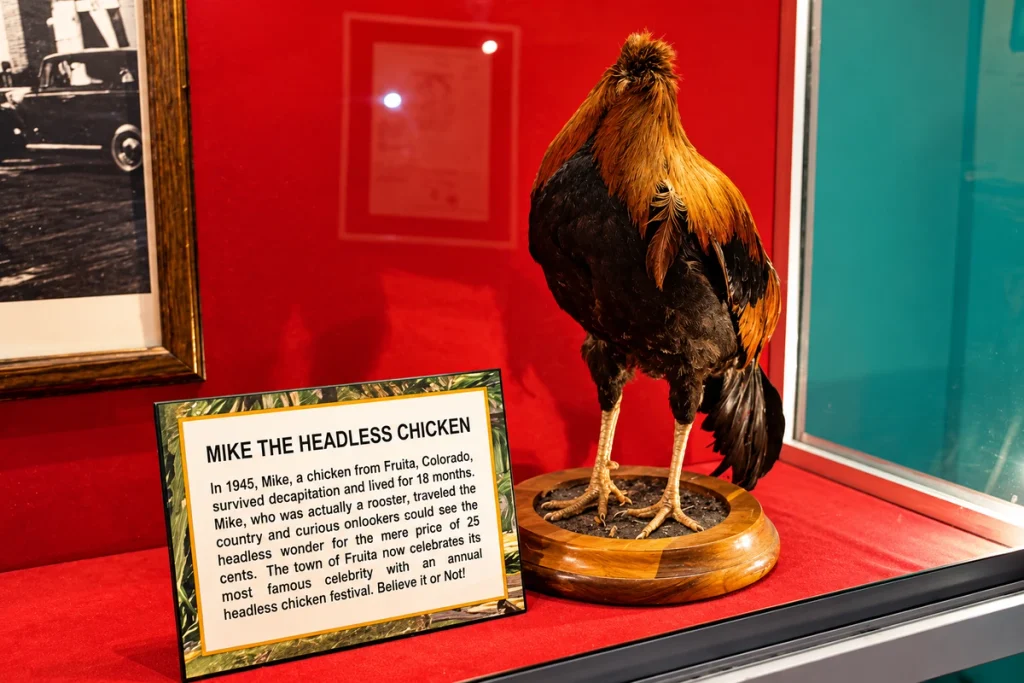
Imagine starting your day with the unbelievable news that a chicken is still alive despite having no head. Sounds crazy, doesn’t it? Well, that’s exactly what happened in 1945 in Colorado. A chicken that lost most of its head managed to survive for around 18 months. But what’s more amazing is that a mix of factors, some biological and some down to earth, allowed him to live for such a long time.
A Farming Accident Nobody Expected
On September 10, 1945, farmer Lloyd Olsen decided to prepare some chicken for dinner. Among the birds he planned to slaughter that day was a young Wyandotte rooster. When Olsen swung the axe, the blow knocked off most of the young rooster’s head. Surprisingly enough, it left some of his vital nervous system intact.
Also Check | The Soldier Who Hid in the Jungle for 30 Years
The young rooster, that would later be called Miracle Mike, did not die as it was expected. Surprisingly, he moved and acted like any other chicken. When Olsen found out, the next morning, that the bird was still alive, he decided to spare the rooster, instead of throwing it away as dead meat.
The Biological Secret Behind Mike’s Survival
Mike’s survival was not something due to a miracle, however. The young rooster’s survival was nothing but an amazing accident.
While Olsen’s axe missed most of Mike’s vital blood vessels, some clotted, stopping him from bleeding to death. But the reason he survived was that some of his brain stem was left intact. The piece of his brain that was left allowed Mike to control some of his body functions, meaning that the rooster would still be alive for another few months.
But Mike’s survival was not a full one. Lacking a beak and eyes, the rooster was unable to eat or see on his own. All that allowed him to survive was the piece of vital neurological tissue and the care of his owner.
The Daily Routine That Kept Him Alive
Keeping Mike alive was something more challenging than most people would expect.
Lloyd Olsen fed the rooster with an eyedropper, giving it food and water to keep it alive. But small pieces of food were given to the rooster as well. Since it lacked a beak and the ability to swallow, Olsen had to use a syringe to remove mucus from Mike’s throat everyday.
What kept Mike alive was a strict daily routine. Unlike other roosters, the young Wyandotte was unable to do several daily tasks on his own. While Olsen kept him fed, the lack of certain parts of his beak stopped the rooster from eating on his own. The same part, which was missing, prevented Mike from swallowing the food, choking him instead. Thus, Olsen not only kept Mike fed but also had to clear his throat of mucus every day, to prevent a potentially lethal complication.
From a Small Farm to National Fame
News of Olsen’s extraordinary rooster quickly spread, soon attracting paying customers to his farm. But Mike soon got recognized beyond Colorado. The University of Utah even arranged for a scientific examination, while Life magazine published a feature article about the bird. In addition, Mike became a sideshow attraction, travelling across the country. The rooster that almost became a meal for Olsen’s family became a profitable property of his owner. Mike’s fame showed that some of the most ordinary people could become stars with the help of only some good (or bad) luck.
Also Check | The Penguin Who Walked to Buy Fish
The fame also raised ethical questions about the rooster and Olsen. While Mike’s condition fascinated people, it also made them wonder whether it was right to keep the bird as an exhibition piece.
The Small Mistake That Ended His Life
In March 1947, the short, miraculous life of Mike came to an end in Phoenix, Arizona. During one of his tours, the rooster suddenly began to choke. The equipment necessary to clear his throat had been left behind, apparently. Olsen was unable to save the bird, which is why Mike died after 18 months of losing his head.
The circumstances of Mike’s death made his story even more heartbreaking. The conditions he had to live under are said to be one of the reasons why his life was so short.
Why Mike’s Story Still Matters
The story about Miracle Mike is both a lesson about biology and a caution about ethical questions surrounding animal rights and scientific experimentation on animals. These days, Fruita celebrates Mike’s legacy with an annual festival dedicated to the rooster. There are important reasons Mike became an icon of American popular culture. But the most important one is that the survival of the rooster depended on the care and daily regime provided by Olsen.

A passionate blogger, content writer, and digital explorer, specialize in writing engaging, and value-driven articles across diverse niches.
1 thought on “Mike: The Headless Chicken That Survived for 18 Months”