
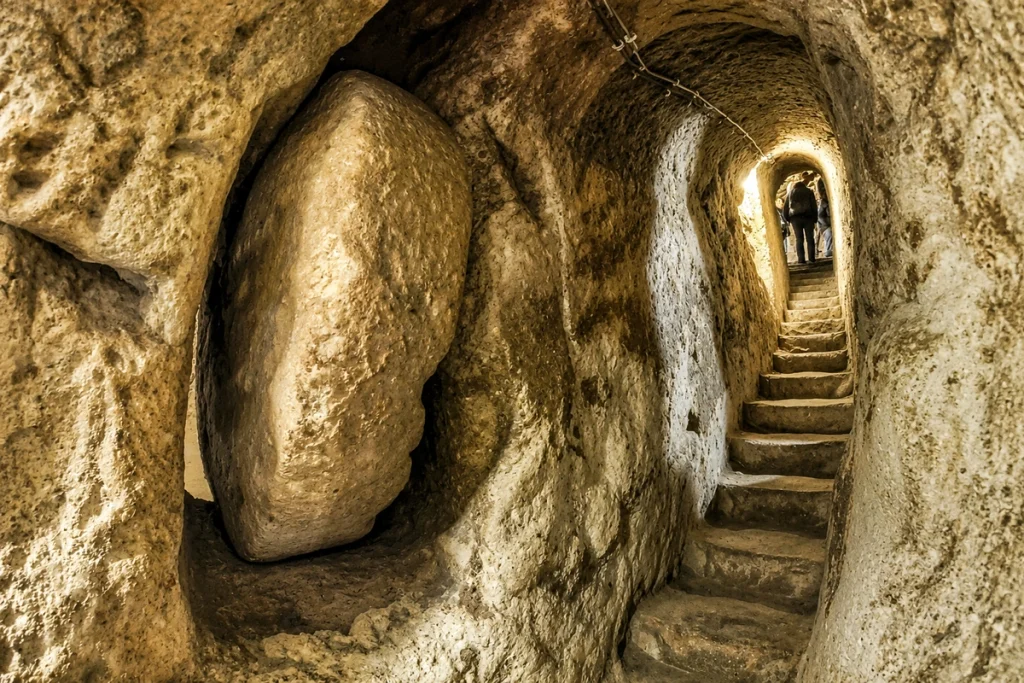
After an argument with his parents, a 14-year-old boy named Andrés Cantó went into his family’s backyard in anger on March 9, 2015. That day, he was not there to build a house underground.
His parents would not let him go to the nearby village while wearing the tracksuit he wanted. Rather than stay inside and argue, Cantó took a pickaxe and started hitting the soil in the backyard of his home in La Romana, Alicante, Spain. What began as a burst of anger turned into something much bigger over time.
What makes Cantó’s story unusual is not only that he dug a cave. It is how the project gradually changed from an outlet for anger into a long-running construction experiment that he kept improving year after year.
At first, Cantó did not even have a proper plan for the space. He later explained that during the first three years, his main aim was just to find out how deep he could make the hole. He keeps working after returning from school and turning excavation into part of his daily routine. The biggest change came when the hole became large enough to imagine as something more useful.
Also Check | The Man Who Sat on a Flagpole for 49 Days
Around 2017, his friend Andreu became joined him and brought a pneumatic drill. That changed the speed of the work considerably. Instead of depending entirely on hand tools, the pair could tackle harder sections of ground and push the excavation more deeper. But removing the earth was another problem.
Cantó initially carried the soil out by hand using buckets. As the hole became deeper, he developed a homemade pulley system to move excavated material back toward the surface. The cave’s shape was also not completely designed in advance. He had to change his plans as big stones and other obstacles appears in his way.
That is one of the neglected parts of the story. Cantó was effectively learning construction by doing it.
He started to think about making the underground space feel safer and easier to be in. As the work went on, he added stronger supports, perfectly shaped openings, and higher ceiling sections. Later, when the cave finally looked like a real hidden getaway, it was no longer just some hole in the garden.
It had separate areas, stairs, a bed, seating, lighting, heating and a music system. Wi-Fi was also made available by using a phone near the entrance to relay the connection underground. Reports from the period put the space at roughly several square metres, with the exact dimensions varying between accounts.
The underground location also created an unexpected advantage. During Alicante’s summer season, Cantó said the cave could remain near 20 to 21 degrees Celsius. That is much lower than what is outside. That made the space useful as a place to escape the summer heat, not just a strange room to sleep in. However, underground living was hardly perfect.
Cantó said the cave could become damp, had limited air circulation, and even flooded during heavy rain. Sometimes insects, spiders and even snails could be seen inside. So behind the viral images of a surprisingly comfortable underground room was a much messier reality of moisture, excavation and constant maintenance.
There was another surprising chapter too: the authorities.
Because Cantó was digging beneath his family’s property, questions eventually arose about whether the unusual structure was legally acceptable. Reports say officials inspected it, and they did not find an immediate issue. The excavation was hard to place under common labels such as a conventional basement, extension or storage building.
By 2021, the story gone viral all over the world. Yet Cantó did not describe it as something he wished he had not done. He said he had always enjoyed building small huts and structures as a child, suggesting that the clothes argument may have been only the spark. The fascination with building had already been there.
Also Check | The Incredible Man Who Cheated Death Seven Times
The cave was never really about the argument. The argument gave a bored 14-year-old a reason to pick up a tool. The digging gave him a routine. The routine became a hobby. The hobby became construction. And construction eventually became a work that followed him into adulthood.
A January 2026 report says Cantó had continued developing the cave for around a decade, returning to La Romana on weekends while studying acting in Murcia.
So the famous underground room was not the result of one extraordinary burst of teenage determination.
It was built through thousands of ordinary decisions: dig a little more, remove another bucket of soil, reinforce another section, solve another obstacle and come back tomorrow.
What started as a teenager’s answer to being told to change his clothes ultimately became a reminder of what can happen when a temporary burst of frustration collides with a very persistent imagination.

A passionate blogger, content writer, and digital explorer, specialize in writing engaging, and value-driven articles across diverse niches.
1 thought on “Andrés Cantó: The Boy Who Builds An Underground Cave in Anger”