
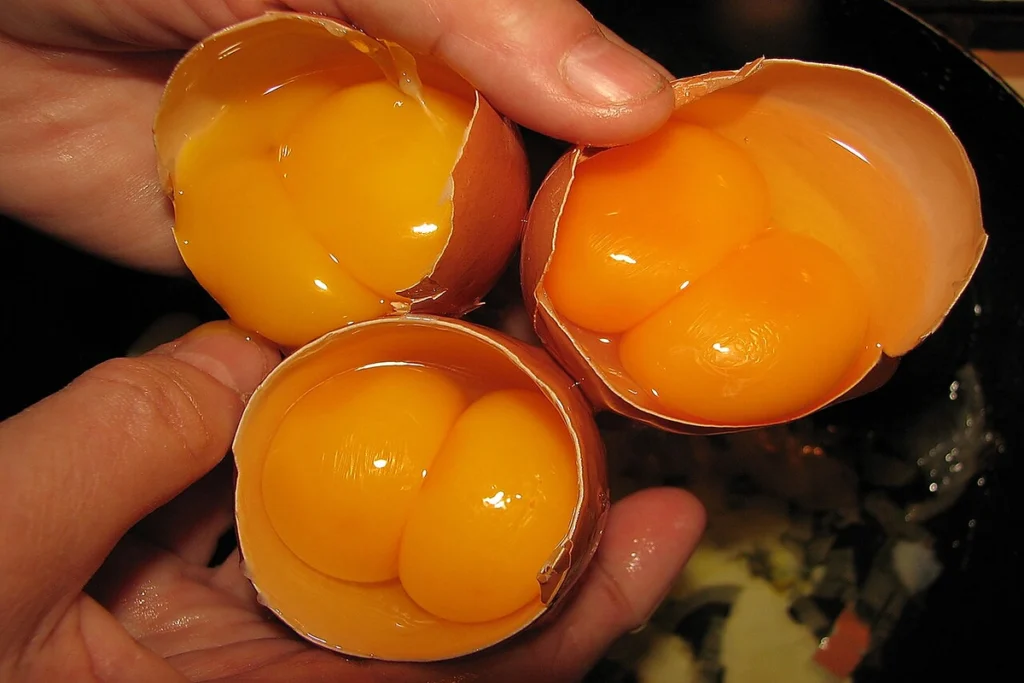
Imagine breaking an egg and expecting that one lone yolk, then you notice two bright yellow yolks, side by side. It’s strange enough that many people treat it like a lucky omen or some hidden mystery. But how a Double Yolk Egg Forms is more like a supernatural biology story, not superstition. Researchers have been looking into it for years, and what they found is that it comes from a simple change in how a hen’s reproductive system lines up.
A regular egg starts its life inside a hen’s ovary, where thousands of tiny yolks develop gradually. Usually, one yolk becomes mature, and then it gets released during ovulation; from there, it moves into the oviduct. As it travels through this long, twisting tube, layers of egg white get added around it, then come thin protective membranes. Later, calcium is involved, and that’s how the hard shell is created, and the whole routine often runs about twenty-four to twenty-six hours before the hen lays the finished egg.
A double yolk egg forms when two fully mature yolks get released pretty close together, and not just a single one. Instead of moving both yolks separately, they end up slipping into the oviduct nearly at the same time. Because they stay near each other for the full trip, the hen’s body wraps both with the same egg white, the same protective membranes, and the same outer shell. So in the end you get one large egg, with two yolks that look fully formed, like they were planned that way.
Also Check | Why We Can’t Remember Our Early Childhood Memories
It does sound unusual, sure, but it’s basically just a rare variation inside the normal egg-making process.
Young hens are the ones most apt to turn out double yolk eggs because their reproductive systems are still kind of settling in after they first start laying. Older hens can do it too, since hormone levels get a bit more unruly over time, and then sometimes things don’t line up so neatly. Genetics also shows up here; some breeds seem to produce double yolks more frequently than others, basically just by nature of how they’re built. And there can be temporary hormonal shifts, like when two yolks are released in the same ovulation cycle; that ends up being the story.
Even so, double yolk eggs aren’t super rare, even if a lot of people never stumble across one. Poultry experts often say it’s about one egg in a thousand. Backyard chicken keepers usually find them more often, mostly because they tend to keep younger hens. But on commercial farms, the laying flocks are older, so they just see fewer of them.
One question that makes people more curious is whether two chicks can actually hatch from one double-yolk egg. It is only possible if both yolks are well fertilised, but real twin hatching is pretty rare. Two embryos trying to grow inside one shell doesn’t give them much space at all, so survival becomes tough. A handful of unusual cases have been noted, yet in most double yolk eggs you don’t get two strong chicks.
Also Check | Prehistoric Human Diet: What Our Ancestors Really Ate
Modern poultry farms have gotten pretty good at catching these odd eggs before they hit the stores. A lot of producers use candling, which is basically a bright light shining through the shell so you can see what’s on the inside. Bigger farms also use advanced X-ray scanners and automated sorting systems, where they can spot eggs with two yolks fast without cracking or damaging them. Some companies even sell cartons made entirely from naturally occurring double yolk eggs, which is a niche market, I guess.
For centuries, people have given double yolk eggs special significance, and it sticks around. In some parts of Europe, they’ve been tied to good fortune and prosperity, while a few Asian traditions connect them with happiness, marriage, or family growth. In America, many people just treat them as a lucky little surprise they want to share with somebody. Science says that these eggs are just the product of normal biological variety.
Seeing two yolks inside a single shell is a quiet reminder that nature doesn’t always stick to perfect routines. A little shift during ovulation can lead to one of the more intriguing surprises hiding inside what looks like an ordinary egg from the outside. So rather than being mysterious, a double yolk egg is a striking demonstration of how small biological differences can produce something that still manages to amaze people across the world.

A passionate blogger, content writer, and digital explorer, specialize in writing engaging, and value-driven articles across diverse niches.