
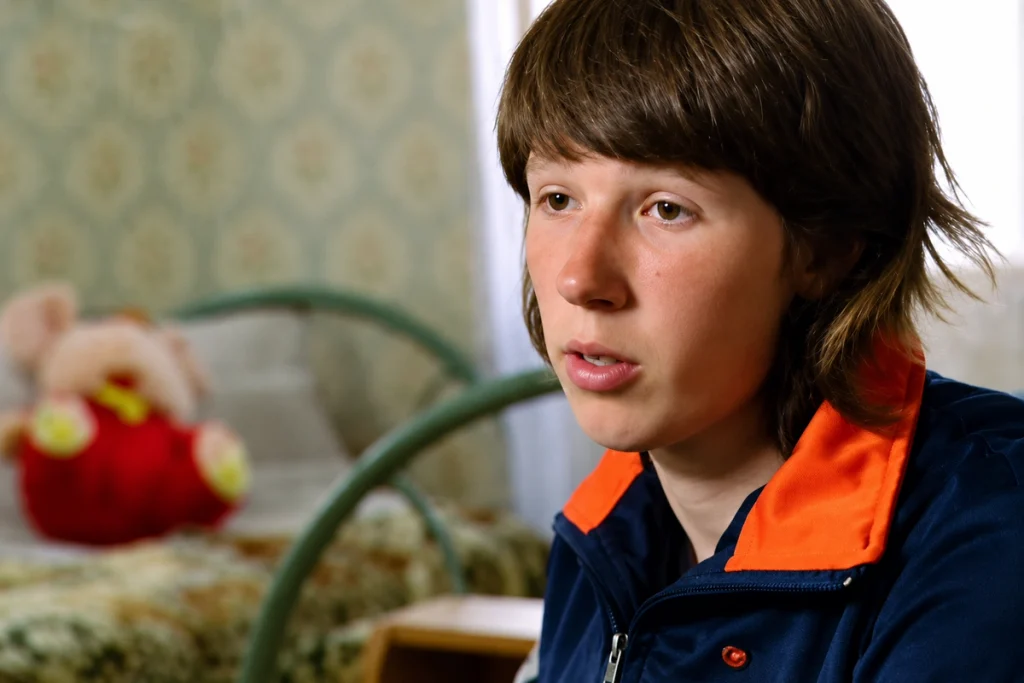
When people hear about a girl who lived with dogs for years, they probably imagined some kind of a mysterious child who somehow managed to become more beast than human. But the tragic case of Oxana Malaya, a Ukrainian woman found living with dogs in 1991, actually deals with a different matter. Her story is gruesome and serves as a reminder that children need more than occasional help to function properly as adults in human society.
A Kennel Became Her Refuge
Oxana Malaya was born in 1983 in Ukraine. When she was approximately 3 years old, she was brought to the dog kennel, where she would live until 1991. There are various reasons to believe that the girl had been abused at home and did not have a functioning family at the time.
Living in the kennel meant that Oxana had a roof over her head and someone to feed her. She spent years living with dogs, wearing their skin, scratching themselves, crawling on all fours, barking, growling, gnawing, and eating from the floor.
Her case is not an example of a human living with animals. The key difference is that Oxana’s life with dogs was not fully developed, and the girl did not receive the maternal love, support, and nurturing that every child receives from their parents (or, in this case, caretakers).
Also Check | The Penguin Who Walked to Buy Fish
The Dogs Were Not the Real Mystery
The most confounding part about Oxana’s story is not the fact that she lived in absolute poverty surrounded by animals but that her behavior appeared to have been so feral. After she was discovered, many reporters asked themselves where the wildness in her came from.
When children are left alone for a while, they often copy what they see. They may also make their own little system of expression. They use sounds to show what they want. As time goes on, these sounds may help them reach other people. This can happen before they fully grasp how human language works. Oxana had dogs to communicate with, so barking probably was a way to fulfill her need to interact with other living creatures.
Similarly, crawling likely was a way to move that felt natural to her at the given time. Her world was the kennel, and the dogs were her friends, so she behaved like any other creature in that domain would have.
Oxana’s wild side might not prove that she was always meant to act that way. Children who grow up without parental guidance, or in dysfunctional family, may display animalistic tendencies. They may do this because they never get clear lessons on how to act around other people. Oxana’s treatment was most likely inadequate, and the conditions that she lived in could hardly be considered suitable for human development.
The Rescue Was Only the Beginning
When the authorities finally managed to reach Oxana in 1991, the dogs had bite marks on the rescuers’ hands. People had to entice the animals away from the girl with food. Then, Oxana was taken away from the kennel, but the rescuers understood that this was only the beginning of a long process.
She had to learn a lot of what children typically acquire at home from their parents. That included language, basic manners, and a sense of confidence that she could handle herself. The biggest part was speaking with ease.
Children develop this skill by watching the adults around them and taking in what those people do. As time passes, they able to say more words. They also start to grasp ideas that are harder to put into simple sentences.
After the rescue, Oxana was in rehab for a long time. She worked on talking again. She also practised more precise ways of speaking. Over time, she learned to behave in ways that met people’s expectations.
It was not easy. Still, she kept going. Over time, she got better and stronger. In the end, she became able to live on her own and function like a normal adult.
Her situation indicates that feral children can eventually be rehabilitated and reintegrated into society. At first, they seem odd. Still, they can learn in their own way. It takes longer than normal. Over time, they adapt to where they live.
The Problem With Calling Her a Dog Girl
The sad reality of Oxana’s case is that it attracts people’s attention due to its sensationalism. Therefore, the media outlets tend to focus only on the bizarre aspects of the story, asking lurid questions and trying to obtain “proofs” that the woman still behaves like a dog.
They fail to report that Oxana was not always like that and that her appearance was only a part of the larger issue. In reality, it could be demonstrated that she was capable of great kindness and gentleness. If someone wanted to see a real-life example of a “dog girl,” this is the one: a survivor who endured extreme situations and ultimately regained her humanity.
Her story provides answers to more important questions that deal with the fundamental nature of human identity and how people treat each other. When Oxana was displayed barking like a dog on camera, people immediately began speculating whether she actually continued to live like an animal most of her life. However, the truth is that she was only a child when that happened.
The most important thing that her story says about humans is that they are incredibly cruel creatures. Behind every monstrous act performed by one person against another, there is usually an even darker force – the indifference of society. People rarely seek to understand what happened to Oxana Malaya and her family. Instead, they focus only on the most spectacular parts of the story.
Also Check | Dog Walked 2,551 Miles Across America to Find Home
What Oxana Malaya’s Story Really Reveals
Oxana Malaya’s childhood teaches a cruel lesson about the nature of humanity. Oxana lived a life of degradation and abuse because no one cared to stop it. The discovery of her living in a kennel alongside dogs serves as a reminder that children need more than occasional help in order to survive.
The dogs provided her with companionship and food, but they could not replace the role of parents in her life. The most horrifying revelation associated with Oxana’s case is that no one in Ukraine seemed to care about the girl’s wellbeing at the time.
Children need love and support, including long hours of human interaction that allow them to learn how to speak and act like humans. Oxana never had that, and the later stages of her rehabilitation only prove that her childhood was exceptionally lonely.
Ultimately, Oxana’s story is not a story about dogs. It is a narrative about the life of a woman who survived under the most difficult circumstances. The real miracle of Oxana Malaya’s life is that she lived through that ordeal, not that she had lived like an animal.

A passionate blogger, content writer, and digital explorer, specialize in writing engaging, and value-driven articles across diverse niches.
1 thought on “Oxana Malaya: The Girl Who Raised by Dogs”