
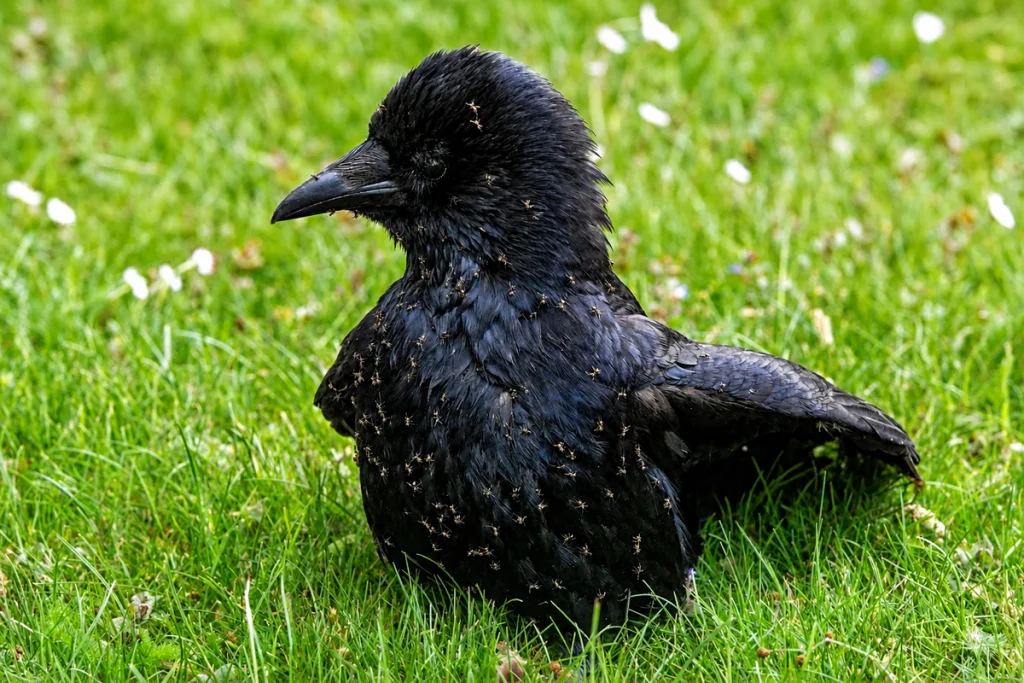
Crows have been seen using ants on their own bodies, and recent studies from researchers hint that this act might be about more than simple grooming.
You might watch a crow drop to the ground. Then it spreads its wings and lets many ants move through its feathers. To a person, it can feel unreal, like the bird chose a strange type of bath.
Scientists describe this process as “anting.” Some birds grab ants in their beaks and smear them into their plumage. Other birds place themselves over an ant line and let the insects cross their skin and feathers. Crows are part of the group that can do this.
Now the main question comes to mind. Why would any bird allow insects that can sting or release harsh chemicals to crawl over it?
Also Check | The Boy Who Builds An Underground Cave in Anger
In that view, many ants release formic acid as a defense. When the ants feel danger, they squirt the acid out. A crow then moves through the ants and spreads that liquid on its own feathers. Because of this, some scientists suspect anting could reduce parasites. They also wonder if it might destroy germs like bacteria or fungi near the bird’s skin.
Still, there is a missing step. No one has shown plain, direct evidence that parasite control is the main reason for this behavior. During a lab test, the scientists found that the ant chemicals did not show the strong anti-germ effect that people expected. The result was not as strong as what is seen in real life. With that type of outcome, it is tough to argue that birds use ants like a medicine.
Another explanation is also on the table, and it suits crows well.
The bird may get some benefit from eating the ants. The same formic acid that scares off enemies can also make the ants hard to eat at first. If the bird first rub the ants on its feathers before biting, it could let more of the acid spread out before the bird consumes the ants.
But recent observations in India raise an even more fascinating possibility: crows may not always discover anting entirely on their own.
Also Check | The Science Behind Nature’s Rare Double Yolk Egg
In Coonoor in the Nilgiris, researchers recently documented a Large-billed Crow actively anting around yellow ants. What makes the observation unusual is what happened afterwards. Two House Crows performed similar behavior after watching the Large-billed Crow. The researchers described this as possible social facilitation between closely related but different crow species.
That detail changes the story.
Instead of thinking of anting simply as an instinctive “ant bath,” it raises the possibility that crows can notice what another bird is doing, recognize that the behavior may be useful and then try it themselves.
Crows are already famous for their ability to learn from their surroundings. They remember faces, solve problems and adjust their behavior based on experience. Seeing another crow deliberately lying among ants could therefore provide a surprisingly simple lesson: whatever that bird is doing might be worth trying.
One big question is still open. No one knows how crows end up anting. Do they learn it from other crows? Or do they figure it out on their own and then pick it up from friends later? Another option is simpler. They may just react to the same setting that also makes ants easy to find.
Even the kind of ant could play a role. Studies suggest that birds do not always grab any ant they see. They may choose ants with certain chemical defenses.
Also Check | The Man Who Sat on a Flagpole for 49 Days
So when you see a crow “bathing” in an ant pile, it might not be as odd as it looks. The bird could be cleaning its feathers. It could be trying to make food. It might be testing what the chemicals do. Or it could be picking up a habit by looking at another bird.
That is probably the best part of anting. We can tell what the crow is doing. We still do not fully know how it decided that ants are worth the trouble in the first place.

A passionate blogger, content writer, and digital explorer, specialize in writing engaging, and value-driven articles across diverse niches.