
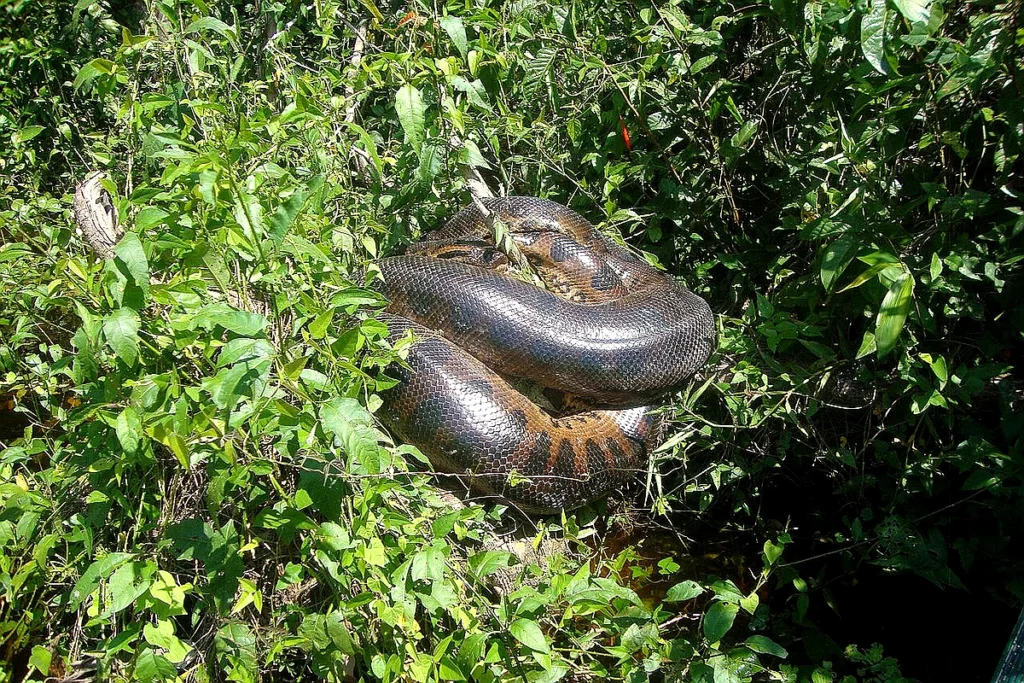
Giant Anaconda Amazon stories have always brought strange fear, and mystery with them. People imagine about a massive snake gliding quietly through dark rainforest water, it feels almost impossible to notice, until its come too close.
But the newest research shows that the real mystery isn’t only about size. It’s also about who it really is, how it changed over time, and what kind of secrets are still hidden inside the Amazon.
For a long time, most people known the green anaconda was the one well known, giant snake. Now scientists say the whole thing is more complicated than that.
What New Research Revealed
Recent research figured out that the northern green anaconda, is its own separate species from the southern green anaconda.
The northern one is called Eunectes akayima, while the southern one known as Eunectes murinus. They look very much the same though, but their DNA tells a different story.
Scientists think the two may have split up around ten million years ago. So it’s like two big anaconda lineages have been living apart for an incredibly long time, even if most people assumed they were the same snake, for years.
Also Check | A Strange Frog That Gives Birth Through the Skin
The Snake That Was Hidden in Amazon
The discovery of Giant Anaconda in Amazon is a great example of what scientists call a cryptic species.
A cryptic species is an animal that looks almost the same as another animal, but they have different DNA, behavior, body structure, and even history.
That’s why this discovery feels so surprising. The snake was not hiding because it was small or hard to find. It was hiding because it seemed way too familiar.
So basically, scientists were thinking they looking at a giant snake they already knew, but the snake had a deeper identity.
Northern Green Anaconda vs Southern Green Anaconda
| Feature | Northern Green Anaconda | Southern Green Anaconda |
|---|---|---|
| Scientific name | Eunectes akayima | Eunectes murinus |
| Known region | Northern Amazon areas | Southern Amazon and nearby wetlands |
| Appearance | Very similar to the southern species | Very similar to the northern species |
| Genetic difference | Reported as clearly separate | Reported as clearly separate |
| Evolutionary split | Around ten million years ago | Around ten million years ago |
| Why it matters | Shows hidden diversity in the Amazon | Helps compare anaconda evolution |
Why the Ten Million Year Split Matters
Ten million years is hard to imagine, so try it like this. Those snakes, maybe they were on their own evolutionary lanes, long before modern humans even showed up.
Over time the rivers positions are changed, the forests shifted, the climates drifted around, and different animal groups got separated. When groups stay apart for a long stretch they can slowly become different species.
That is basically why this split matters. It helps scientists to understand that the Amazon is not just one huge green block of trees. It’s a living place where rivers, wetlands and the land itself can guide life for millions of years.
Also Check | Why We Forget Our Early Childhood Memories
How Scientists Find the Giant Anaconda
Scientists didn’t just walk into the rainforest and somehow find everything on their own. Indigenous knowledge helped the search. Local communities of amazon understand the rivers, animal behavior, and hidden places of the forest in a way outsiders often cannot.
In the Amazon, this kind of knowledge matters deeply. People who live close to the land can notice patterns that science may miss at first.
That makes the story more meaningful. The discovery of a giant snake was not only a laboratory success. It was also a reminder that local knowledge can help to protect and understand wildlife.
The Anaconda as an Amazon Pollution Warning
The Giant Anaconda in the Amazon forest might also be a warning sign for how well, or poorly, the rainforest is doing.
Giant anacondas stay close to the top of the food chain. They hunt down large animals and spend lot of hours in the water. Because of that, pollution coming from rivers and wetlands can slowly build up inside their bodies, over time.
Researchers have been examining anacondas as possible markers for environmental damage, including contamination connected to oil operations and heavy metal deposits.
That really matters since the same dirty water can affect fish, wildlife, and even people in the area. So, the anaconda isn’t just a strong predator. It could also uncover damage that is hiding out within the Amazon ecosystem.
How Big Can the Giant Anaconda Really Get
This is where facts and viral claims need to be separated.
Online stories often describe anacondas as impossibly huge snakes. Some claims are not supported by strong evidence.
Real green anacondas are still enormous. Large females can grow longer and heavier than most snakes on Earth. They are often called the heaviest snakes alive, even if the reticulated python may grow longer.
Reports of extremely large anacondas do exist, including local accounts from remote areas. But scientists usually need careful measurement before accepting record-breaking claims.
The truth is already pretty clear without any exaggeration. An adult anaconda is a huge water hunter, with an incredible strength, stealth, and patience.
Also Check | Famous Foods That Were Made by Mistake
Why Anacondas Became Giants Millions of Years Ago
New fossil research gives this mystery an even older layer.
Fossils from Venezuela suggest that anacondas became large around twelve million years ago and then stayed large for a very long time.
That is unusual because many ancient giant animals disappeared or changed as the world changed. Anacondas seem to have found a body design that worked.
Their size helped them dominate wetland habitats. A big body allowed them to hunt larger prey, survive in water, and reproduce successfully.
In simple words, becoming giant was not a mistake. For anacondas, it was a winning survival plan.
The Giant Anaconda Mystery Map
Northern Amazon: possible home of the northern green anaconda.
Southern Amazon: home of the southern green anaconda.
Flooded forests: where size, stealth and water hunting matter most.
Indigenous territories: where local knowledge helps scientists locate rare animals.
Polluted waterways: where anacondas may reveal hidden environmental damage.
Fossil sites in Venezuela: where ancient bones show anacondas were already giants millions of years ago.
The Unanswered Questions Scientists Still Have
Even after all these discoveries, the mystery is not solved in a proper way.
Scientists still have to figure out where the northern and southern species meet, how their populations are moving over time, and if there are more different species hidden across the Amazon.
They also need to see how pollution, habitat destruction and climate change, might affect these enormous snakes later on.
That is why the Amazon anaconda keeps being so captivating. It is not simply a huge snake from old legends either. It’s a living hint about the rainforest’s past, its present, and also what might come next.
And the more researchers examine it the more it becomes clear. The Amazon is still keeping secrets, far bigger than anyone thought.

A passionate blogger, content writer, and digital explorer, specialize in writing engaging, and value-driven articles across diverse niches.