
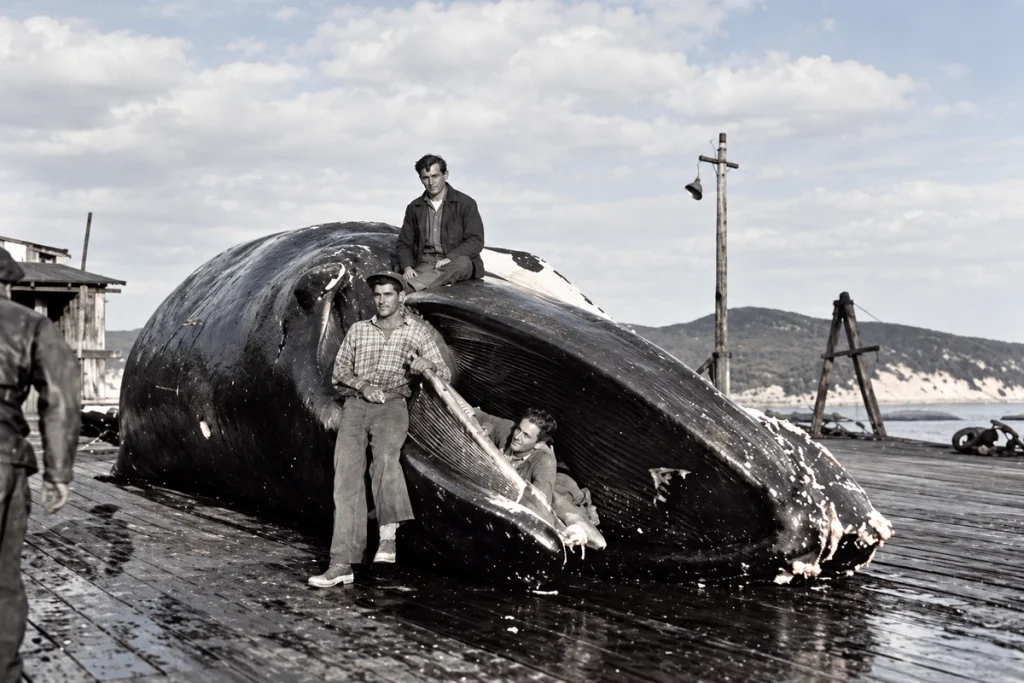
In the late 19th century, people suffering from painful joints could travel to a small Australian whaling town for a treatment that sounds almost impossible today. They were not visiting a hospital or a specialist clinic. They were waiting for a whale.
The strange treatment became associated with Eden on Twofold Bay in New South Wales, where whales were brought ashore during the whaling season. Patients suffering from what newspapers called “rheumatism” would wait until a suitable whale arrived. Then they were taken to the whaling works and lowered into the carcass.
That detail is important because the famous name “Whale Hotel” can be misleading.
There wasn’t a hotel made out of whales. Historical reports describe a hotel in Eden where sufferers gathered while waiting for a whale to be caught. When one arrived, the patients were transported to the whaling works for the bizarre treatment. A medical journal from the period also repeated the description of an Eden hotel where rheumatic patients congregated before being taken to the whale.
Also Check | Kentucky Meat Shower: Why Did Meat Fall From the Sky?
The treatment itself was remarkably simple. Whalers cut an opening into the whale’s body and created a space large enough for a patient to enter. The person would be surrounded by the warm blubber and tissues of the recently killed animal, with the head remaining outside. According to Louis Becke’s account, the opening was closed as much as possible because the whalers believed the gases escaping from the decomposing body were responsible for the supposed cure.
And here is where the story becomes more complicated than the viral version suggests.
The famous explanation says the practice began when a drunken man accidentally fell into a partially opened whale. His friends reportedly could not immediately rescue him because of the heat and smell. After spending hours inside, he emerged sober and supposedly discovered that his rheumatic pain had disappeared. Newspapers later presented this as the accidental discovery of the whale cure.
But there is no solid evidence that this man actually invented the practice.
Becke, who documented the treatment in A Memory of the Southern Seas, specifically said he did not know how the cure had been discovered. He also wrote that American whalemen had known about it for years. That creates a fascinating gap between the entertaining origin story and the historical evidence.
There is another detail that tends to disappear from modern retellings: the treatment wasn’t necessarily one continuous 30-hour session.
Becke described patients being removed when they could no longer tolerate the conditions and returning for additional sessions. He wrote that 20 to 30 hours in total was supposedly enough for severe cases, rather than necessarily spending an uninterrupted day inside a whale.
One firsthand-style account published in 1896 described a patient spending about an hour and twenty minutes inside a whale that had already been dead for roughly 40 hours. The writer described extreme heat, pressure and bursts of gas. He claimed his rheumatic pain disappeared afterwards, but also said it returned exactly 12 months later.
Also Check | The Mushroom That Makes People See Tiny Elves
The historical accounts contain claims of relief, not proof of a cure. There was no controlled medical experiment demonstrating that whale gases treated joint disease. Even the word “rheumatism” creates uncertainty because it was a broad historical term covering various painful conditions rather than one precisely defined modern diagnosis.
So the real mystery surrounding the Whale Hotel isn’t simply why anyone would climb inside a dead whale.
It is how an accidental anecdote, traditional whaling knowledge and untested medical claims combined to create an unusual treatment that newspapers could present as a genuine cure.
For a brief period, Eden became associated with one of history’s strangest remedies.
The whale was eventually stripped for oil and other products.
The patients went home.
And the supposed cure disappeared almost as quickly as it had arrived.

A passionate blogger, content writer, and digital explorer, specialize in writing engaging, and value-driven articles across diverse niches.
1 thought on “The Whale Hotel: How a Dead Whale Became a Medical Treatment”