
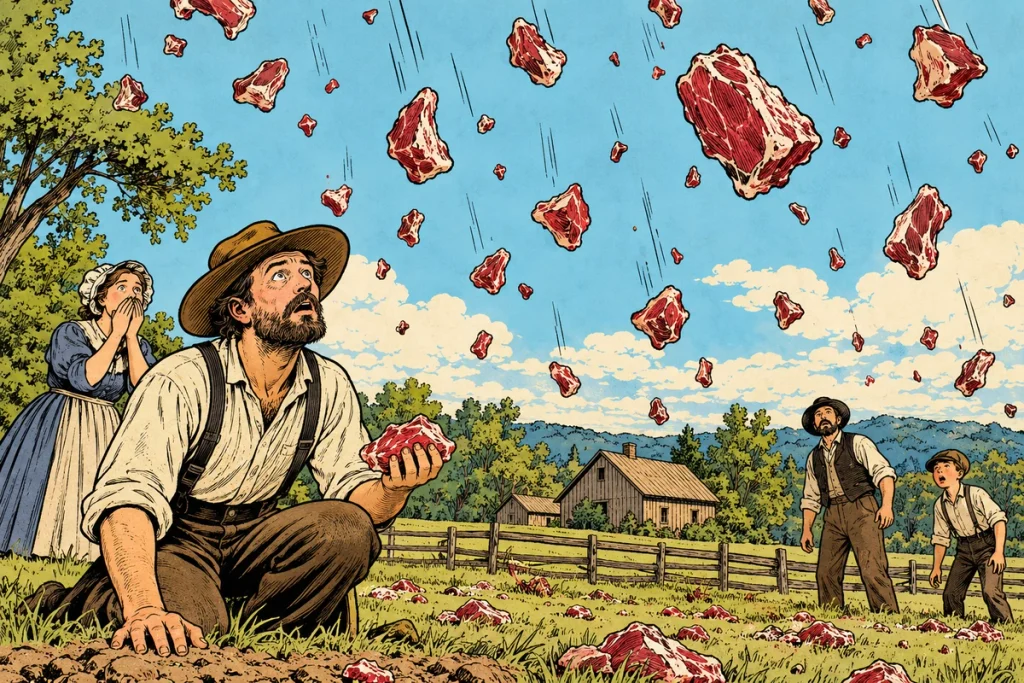
On March 3, 1876, something deeply strange happened near Olympia Springs in Bath County, Kentucky. Pieces of what appeared to be fresh meat began falling from a clear sky around the farm of Allen and Mrs. Crouch. The shower lasted only a few minutes, but it left an area roughly 100 yards long and 50 yards wide scattered with strange red fragments. Some pieces were small, while others were several inches across.
The story usually ends with a bizarre but convenient explanation: vultures had eaten carrion, taken flight and then suddenly vomited their stomach contents. That theory was actually proposed in 1876, not invented by modern internet writers. But there is another part of the Kentucky Meat Shower that deserves more attention.
The real mystery may not be where the meat came from. It may be how anyone could be certain that all the samples being studied were from the same event.
When word spread, pieces were collected and sent to different investigators. One early investigator, Leopold Brandeis, suggested that the material might be Nostoc, a jelly-like cyanobacterium that can swell dramatically when wet. That idea did not survive microscopic examination particularly well. Other investigators reported structures resembling animal tissue.
Also Check | The Incredible Man Who Cheated Death Seven Times
Dr. Allan McLane Hamilton and other microscopists examined specimens and described lung tissue, muscle and cartilage. One examination reportedly found lung tissue whose structure could have belonged to either a horse or a human infant. Later accounts describe seven examined samples, with two identified as lung tissue, three as muscle and two as cartilage.
That sounds like a scientific solution, but it creates an important question.
Were those seven pieces independently proven to have come directly from the Kentucky field?
The surviving historical record does not give us the kind of modern chain of custody that would settle that question. There was no sealed evidence bag, photographic record of every specimen, laboratory accession number or documented transfer from the farm to a modern testing facility. One historical reconstruction specifically notes that the provenance of the individual samples remains unresolved.
This does not mean the meat shower was fabricated. Contemporary newspapers and scientific publications reported the incident, and the original accounts describe witnesses seeing material fall around them. The event itself has a much stronger historical record than many internet mysteries.
But identifying the material as animal tissue is different from identifying its source.
That distinction is important because the vulture explanation depends on another missing piece of evidence: nobody is known to have actually watched a flock of vultures disgorge the material over the Crouch property that morning. The theory makes biological sense. Vultures can regurgitate food when threatened or when they need to become lighter quickly, and contemporary physician L. D. Kastenbine argued that a flock could explain the mixture of tissues found in the samples.
Yet a plausible mechanism is not the same thing as direct proof.
There is even an intriguing detail hidden in the old investigation. Different observers tried to identify the material by appearance, smell and taste. Some thought it resembled beef, while two men who tasted it reportedly suggested mutton or venison. Later microscopic examination produced a completely different level of information by showing recognizable animal tissues.
So the Kentucky Meat Shower may be better understood as an unfinished nineteenth-century investigation.
Also Check | How a Double Yolk Egg Forms
The scientists got surprisingly far. They established that at least the examined material looked like genuine animal tissue. A vulture event remains a reasonable explanation for how such tissue could suddenly appear over a small area. But the final link, connecting every surviving specimen to the original shower and then connecting that shower to a specific flock of birds, was never firmly established.
More than 150 years later, that missing link is what keeps the Kentucky Meat Shower alive.
The strangest part is not that meat supposedly fell from a blue sky.
It is that the evidence came close to explaining it, but never quite close enough to close the case.
Source : The New York Times

A passionate blogger, content writer, and digital explorer, specialize in writing engaging, and value-driven articles across diverse niches.